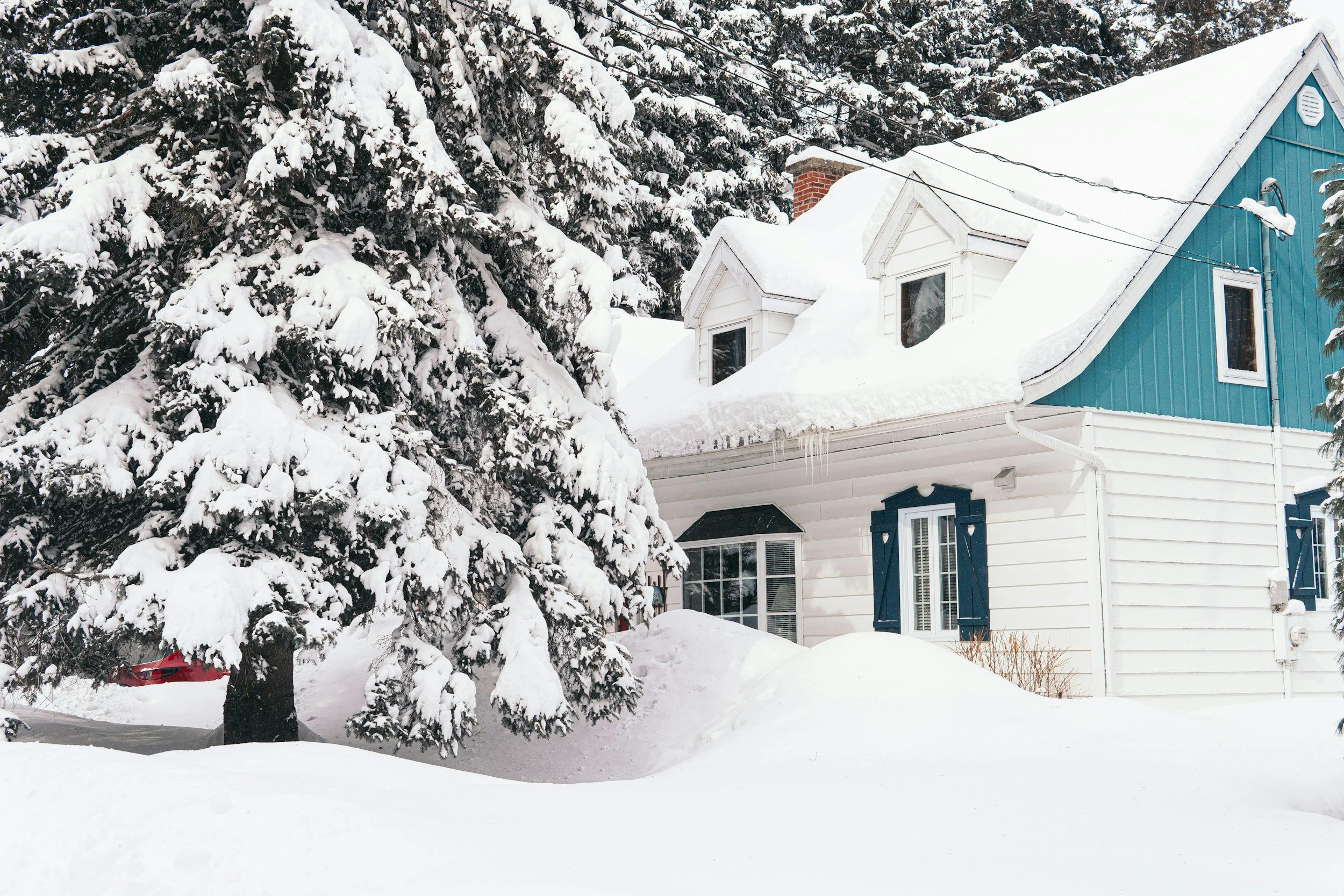
Michigan's building code assigns every county a ground snow load, which is the weight of snow a roof has to be designed to carry. Oakland County is 25 pounds per square foot. Wayne County is 20. Grand Traverse, Leelanau, Benzie, Kalkaska and Antrim are all 60, and five townships at the north end of Antrim (Banks, Central Lake, Echo, Jordan and Warner) are 70.
So the house you're leaving downstate was engineered for a fraction of the snow the house you're buying up here has to hold. That's not a fun fact. It's the reason a 1970s cottage with a shallow-pitch roof and a 2019 build on the same road are two different purchases in February.
The last two winters were not normal, and that matters for pricing a roof
Traverse City's long-term average is 101 inches of snow a year. The winter that just ended came in at 145 inches. The one before it hit 152. Two winters before that, we got 65, which is why everyone's memory of "how bad it gets" depends entirely on which year they moved here.
Last winter also put 88 days of six-inch-plus snow depth on the ground in TC against a typical 57, closed TCAPS for 10 snow days, and dropped 13.3 inches in a single March 15 blizzard. West Bay froze over for the first time since 2019. Gaylord set its all-time record the winter before at just over 204 inches.
Working up here, you learn that snow doesn't hurt a house on the day it falls. It hurts it in week three, when the pile on the north slope has thawed and refrozen four times and now weighs like wet sand. That's the load the code number is talking about, and it's why I'd rather see a steep metal roof on a cheap cottage than a low-slope shingle roof on an expensive one.
Northern Michigan snow is a geography problem, not a weather problem
The number that matters isn't "how much does it snow up north." It's "how much does it snow on this parcel," and the spread is bigger than most buyers expect.
Frankfort, right on Lake Michigan, averages 93 inches. Traverse City averages 101. Petoskey averages 124 and Gaylord averages 140. The lake makes the snow, the wind carries it inland, and the hills wring it out. That's why the interior of Leelanau around Maple City and Cedar, the Benzie highlands south of Honor, and the plateau east of Kalkaska routinely bury the shoreline towns even though they're 20 minutes away.
Elevation and orientation do the rest. A driveway that climbs a north-facing hill off M-72 near Williamsburg keeps its ice a month longer than a flat one on Old Mission that gets afternoon sun. A house sited in a bowl below the road gets every plow's windrow pushed across its apron. None of this shows up in a listing, and all of it shows up on the first Saturday you spend with a shovel.
The honest version: if you're touring Glen Arbor or Cedar in September, you're seeing the property at its most flattering. Ask where the snow goes, because it goes somewhere.
The three questions I'd ask before the first plow bill
We see the same pattern every year with buyers who came up from a 25-psf county. They price the house, they price the taxes, and they don't price the winter until it arrives. These three questions fix that.
1. Who plows to my door, and where am I in the order? On county roads, the road commission clears state trunklines first (US-31, M-72, M-37, M-113, M-137), then county primary roads, then local roads and subdivisions. After a big storm, "then" can mean the next day. On a private road, the answer is whoever the road agreement says, which is a document worth reading before you're the one holding the plow invoice. I've written about how half the best driveways up north belong to you and eight neighbors, and winter is when that math becomes real.
2. Where does the snow go? Look at the driveway and picture 100 inches of it piled on the sides. If there's a lot line, a retaining wall, a septic drainfield, or a neighbor's garage within a plow-blade of the pavement, the snow has nowhere to live by January. Roofs work the same way. A valley that dumps onto a deck, a low porch roof under a tall main roof, or a north eave over the front door are all places where snow stacks instead of sliding.
3. How does the house breathe? Ice dams aren't a snow problem, they're an attic problem. Heat leaks up, melts the bottom of the snowpack, and the water refreezes at the cold eave until it backs up under the shingles. Icicles the size of your arm are the tell. Insurers have started paying attention to this, and I covered why in the post on how Michigan home insurance jumped nearly 50% and what decides whether you even get a policy.
What this means for the house you're actually looking at
A pre-1990 cottage with a 4/12 roof and no ridge vent isn't a dealbreaker. It's a line item. Get a roofer or a structural inspector to look at the rafters, the sheathing, and the eaves before you close, especially if the listing photos were shot in July and nobody has seen the roof under load.
New construction in a 60-psf county is designed for the load by definition, which is one of the quiet reasons a 2020s build in Elmwood Township or Williamsburg carries a premium over a similar-sized older house. You're paying for trusses, not just finishes.
And if the property is a short-term rental, add a fourth question: who shows up at 6 a.m. to plow before a guest's check-in? The 2026 Northern Michigan short-term rental guide covers the rules by township, but the operational side is a plow contract, a roof rake, and a heating budget, which is its own conversation now that the cheap propane window closes October 1.
The part nobody puts in the brochure
Over 25 years up here, Janel has watched the same thing happen every fall: people fall in love with a view in September and negotiate for a house they'll actually live in from December to March. That's not a reason to skip the view. It's a reason to spend 20 minutes in the attic and 10 minutes standing at the end of the driveway imagining it white.
Tour in September. Buy for February.
If you want a second set of eyes on how a specific property is going to handle Northern Michigan snow, send me the address. I'll tell you what I see and what I'd want checked.
Taylor Brown, Realtor
Taylor@taylorbrownrealtor.com
