There's a sentence sitting in almost every unplatted-land deed recorded in Leelanau County since March 31, 1997, and I'd bet money most owners have never read it.
Michigan's Land Division Act, MCL 560.109(4), requires it word for word: "This property may be located within the vicinity of farm land or a farm operation. Generally accepted agricultural and management practices which may generate noise, dust, odors, and other associated conditions may be used and are protected by the Michigan right to farm act."
That's your warning. It sits between the legal description and the tax parcel number, nobody reads it out loud at closing, and it is the most consequential paragraph in the whole document if you're buying anywhere near a cherry orchard or a vineyard up here.
"At Any Time" Is Doing an Enormous Amount of Work
The Michigan Right to Farm Act (PA 93 of 1981) defines a "farm operation" as a condition or activity that occurs at any time as necessary on a farm. Not during business hours. Not between eight and six. At any time.
Then it spells out what's covered, and the list runs longer than people expect: the generation of noise, odors, dust and fumes. The operation of machinery. Field preparation and ground and aerial seeding and spraying. The application of pesticides. And "use of alternative pest management techniques" — the statutory phrase that quietly covers propane cannons.
If a farm conforms to the state's Generally Accepted Agricultural and Management Practices — the GAAMPs — that farm cannot be found to be a public or private nuisance. Not "probably won't be." Cannot be. MCL 286.473(1).
The One-Mile Ring
Here's the part that catches people off guard up here. A farm is also shielded if it existed before a change in the land use or occupancy of land within one mile of the farm's boundaries. MCL 286.473(2).
One mile. Not adjacent. Not across the fence line. A mile out in every direction from the orchard's property line.
Now run that against where we actually live. The 2022 Census of Agriculture puts 57,189 acres of Leelanau County in farms — roughly 89 square miles of a 347-square-mile county — spread across 500 separate operations. Tart cherries alone take up 8,665 of those acres, sweet cherries another 4,476. Grand Traverse County adds 3,117 acres of tart and 1,989 of sweet.
Draw a one-mile ring around every one of those farm boundaries and there is very little of Leelanau, and not much of Old Mission, sitting outside somebody's circle.
Leelanau County ranks 80th in the United States for the value of fruit, tree nut and berry sales — out of 2,711 counties that grow the stuff. Grand Traverse ranks 94th. This is not a place where agriculture is scenery. It's a top-100 fruit region, and the statute treats it like one.
Michigan Wrote the Disclosure, Then Made It Optional
The state actually drafted the exact notice a buyer ought to get. It's MCL 286.473c, and the language is sitting right there in the statute: a plain-English heads-up that you're within a mile of a farm operation, and that noise, dust and odors come with it.
Read the verb, though. A seller within a mile of a farm "may voluntarily make available" that statement to the buyer.
May. Voluntarily. In practice that form almost never crosses a Northern Michigan closing table. It isn't part of the standard Seller's Disclosure Statement, nobody is penalized for leaving it out, so it gets left out. Michigan wrote the warning and then declined to require anyone to hand it over.
What Actually Happens If You Complain
Say you close in February on a place with a beautiful view of rolling orchard, and by the third week of July something is going off every ninety seconds starting at sunrise. You call somebody. Here's the machinery you just walked into.
MDARD is required to investigate, and to conduct an on-site inspection within seven business days. That part genuinely works in your favor, and the Right to Farm hotline is 877-632-1783. There's also real language in the Pesticide Utilization GAAMP telling growers that noise-based bird scaring "should be used in a manner that considers neighbor relations" — not run constantly, only when needed. Plenty of growers up here take that seriously.
But if the inspector finds the farm is using accepted practices, your complaint gets logged as unverified. And bring more than three unverified complaints against the same farm inside three years, and the director may order you to pay the department the full cost of investigating the fourth one and every one after it. MCL 286.474(4). You can be billed for complaining.
Skip the agency and sue instead, and the exposure gets worse. A farm that prevails in a nuisance action recovers its actual costs and its reasonable attorney fees — and in 2022 the Michigan Supreme Court held in James Township v Rice, 509 Mich 363, that a court has no discretion to decline that award. It's mandatory.
Your Township Cannot Save You
This is the question we field most, and the honest answer is uncomfortable: no, the township can't just pass a noise ordinance.
Since June 1, 2000, the Right to Farm Act expressly preempts any local ordinance that extends or revises the act or the GAAMPs. A local unit of government "shall not enact, maintain, or enforce" a conflicting rule. MCL 286.474(6).
There is an escape hatch, and it's narrow enough to be close to theoretical. Under MCL 286.474(7) a township may propose a stricter standard where adverse effects on the environment or public health exist — but it has to send the proposal to Lansing 45 days before enactment, sit through an MDARD public meeting, and then wait for the Michigan Commission of Agriculture to approve it. Your township needs Lansing's permission to regulate the orchard at the end of your road.
The Downwind Test
So here's what we actually run before writing an offer on anything with a farm view. Three questions, one afternoon.
1. What's the crop, and what's its calendar? Tart and sweet cherries are a July-into-early-August story, with crews and shakers running long days and equipment moving before sunrise. Wine grapes are a September-October harvest with frost fans that can kick on before dawn on a cold night in late April. A hayfield is three loud weekends a year. Those are three completely different neighbors, and the word "orchard" on a listing tells you none of it.
2. Which direction does the wind actually come from? Our weather comes off Lake Michigan out of the west and northwest. Sitting east of an orchard is a materially different purchase than sitting west of the same orchard, and an airblast sprayer does exactly what the name suggests. The GAAMPs require applicators to minimize off-target drift and to use a written Drift Management Plan when drift is anticipated — but a no-spray buffer zone is listed as one option among several, not a requirement.
3. Is the ground next door protected, or just currently planted? Not the same thing. A grandfathered farm is explicitly allowed to change ownership, change size, adopt new technology, and change the type of farm product it grows without losing a bit of protection. Land locked into a development-rights program is a different animal — Peninsula Township's voters took a huge share of Old Mission off the table that way, and it's worth knowing which one you're standing next to.
Then do the unglamorous thing and knock on the farmhouse door. In our experience growers up here are remarkably willing to walk you through exactly what their season looks like. Nobody wants the neighbor who moves in and immediately files.
The Part Where I Argue Against Myself
I'm not writing this to talk anyone out of Leelanau. I'd argue close to the opposite.
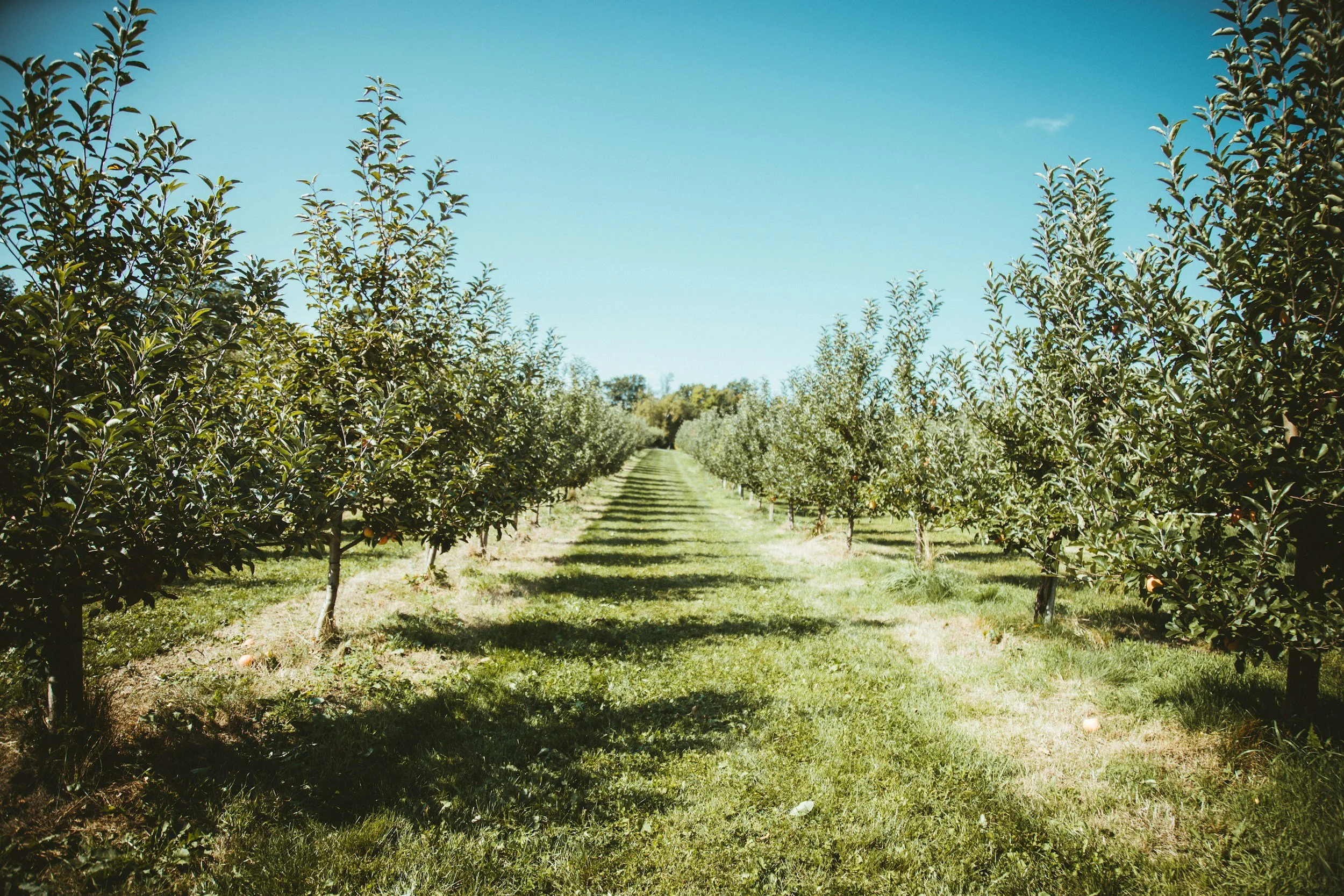
The Right to Farm Act is a big reason the view off your deck is still forty acres of cherry trees instead of forty rooftops. A law that makes it hard to sue a farm out of existence is a law that keeps farms in existence. If you love the way Suttons Bay and Cedar look in October, you're looking at the direct result of this statute plus a lot of stubborn families — the same way the private-road math in Leelanau is the direct result of choices made decades before anybody was buying second homes here.
The mistake isn't buying next to the orchard. The mistake is buying next to the orchard while quietly assuming it's decorative.
One More Thing, and the Clock Is Running
The GAAMPs get rewritten every single year, and the comment window happens to be open right now. MDARD is taking public input on all of the practice sets — including Pesticide Utilization and Pest Control, the one with the cannon language — until 5 p.m. on August 30, 2026. There's a virtual public meeting on August 27 at 1 p.m., and the Commission takes up recommendations September 9.
Almost nobody outside of agriculture ever comments. If you live inside somebody's one-mile ring, you are precisely the person that process was built to hear from, and it costs you one email.
If you're looking at anything in Leelanau or out on Old Mission and want a straight answer about what's growing next door and what that actually means in July, ask us. We'll go stand in the yard with you and look at it. You can browse what's on the market right now here.
Taylor Brown, Realtor
Taylor@taylorbrownrealtor.com
(231) 360-1510
