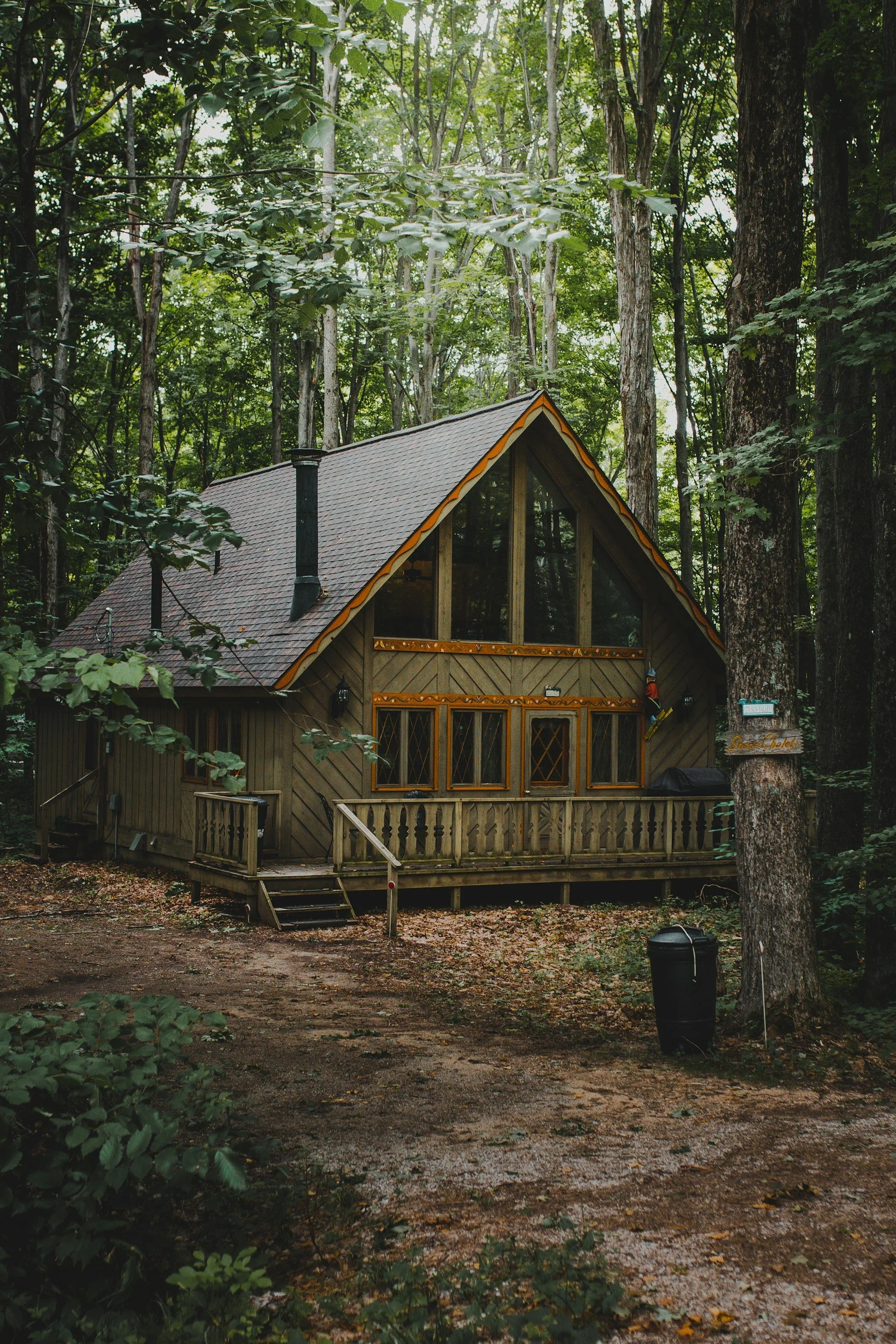
Fifty miles of Leelanau County road never see a plow blade. The road commission calls them seasonal roads — mostly two-tracks, closed to public travel from roughly November through April, which is more or less how the entire county looked a hundred years ago.
To a buyer standing there in July with the windows down, that’s the whole appeal.
To an underwriter in an office park three states away, it’s a reason to decline the loan.
Value and eligibility are two completely different tests
Everybody up here worries about the appraisal. Will the number come in, will the comps hold, does the lake premium translate. Fair worry — we wrote a whole post about what happens when an appraiser who has never seen the lake decides what it’s worth.
But financing a Northern Michigan cottage has a second gate, and it isn’t about value at all. Fannie Mae and Freddie Mac also ask whether the property qualifies as a house under their rules — and a cottage can appraise at full contract price and still be ineligible.
That’s the part that blindsides people. The appraisal answers “what is it worth.” Underwriting answers “will we lend on this at all,” and it grades things no buyer thinks to check in July.
Four things your lender quietly requires of a cottage
Access that works in February. Fannie’s guidelines want adequate legal access to the property, and when the road is privately maintained they generally want a recorded road maintenance agreement — each owner’s share of the cost, a remedy if somebody doesn’t pay, and a term that binds whoever owns the place next. A verbal understanding among eight neighbors and a guy with a plow truck is not that document. We went deep on the private-road math right here.
Heat that’s bolted down. The property needs a permanent, self-fueled heat source — furnace, boiler, baseboard, wall units. Space heaters don’t count, and a woodstove or fireplace as the only heat source generally doesn’t either, which surprises approximately every buyer who has ever fallen in love with a 1950s hunting camp.
A water source Fannie recognizes. Public water or a drilled well. Lakes, rivers, springs, and cisterns show up on the list of unacceptable water conditions — a live problem for a certain generation of cottage that has drawn straight out of the lake since 1961 and never thought twice about it.
Usability twelve months a year. A second home has to be suitable for year-round occupancy. Not that you’ll be there in February. That you could be.
The escape hatch is real, and thinner than it sounds
There is an exception, and almost nobody reads it. Fannie will accept a second home with seasonal limitations — no winter access, for example — as long as the appraiser includes at least one comparable sale with similar seasonal limitations, to demonstrate the property is actually marketable.
Read that again. Your loan can hinge on whether somebody else recently sold a similarly winter-inaccessible cottage close enough to comp.
On the Chain of Lakes, or a two-track back road out near Lake Leelanau, that sale sometimes exists. Sometimes it doesn’t, and there’s no arguing your way around a comp that isn’t there.
Resort condos have their own trapdoor
If a condo project has a rental desk, registration or check-in services, daily housekeeping, a central key system, or units renting nightly, Fannie and Freddie treat the whole building as a hotel rather than housing. Every unit in it becomes ineligible for conventional financing — not because of your credit, but because of the building’s business model.
Northern Michigan has a lot of property that looks like real estate and underwrites like a Holiday Inn. If rental income is part of your plan, the financing question comes before the revenue question — and our 2026 guide to Northern Michigan short-term rentals is the next thing to read.
Why 45% of Leelanau sales went cash isn’t purely a wealth story
Leelanau County closed 375 home sales in 2025: 55% financed, 45% cash, up from 44% cash the year before. The easy read is that this is simply a rich second-home market. Some of it is.
The part nobody says out loud is that a slice of those cash deals are properties that can’t get a conforming loan at any price. When the road isn’t plowed, the water comes from the lake, or the only heat is a woodstove, the buyer pool quietly narrows to people who don’t need a lender’s permission.
That’s leverage if you’re the cash buyer. It’s a pricing problem if you’re the seller — and we see this pattern a lot in our market: sellers who assume the entire buyer pool is available to them when the property itself has already excluded a big chunk of it.
What it costs even when everything checks out
The 30-year fixed averaged 6.66% on July 30, up from 6.58% the week before and a shade under the 6.72% of a year ago. That’s the number everybody quotes around the bonfire.
Here’s the number nobody quotes. Since 2022, Fannie and Freddie have tacked an extra upfront fee onto second-home loans, running from 1.125% to 3.875% of the loan amount depending on loan-to-value — and as of this summer those fees are still on the books. NAHB’s own example: a $300,000 loan at 65% loan-to-value picks up roughly $4,875 in additional fee.
Northern Michigan cottage financing doesn’t just cost more in interest. It costs more at the same interest rate.
The Financeability Test: four questions before you write the offer
Ask these while you still have negotiating room, not during a two-week financing contingency.
Is the road public, seasonal, or private — and is there a recorded maintenance agreement? Ask for the recorded document, not the seller’s summary of it.
Where does the water actually come from? “The lake” is an answer that changes which lenders will talk to you.
Is the heat permanent, and does the plumbing get winterized every fall? Winterizing isn’t disqualifying. Your lender finding out about it in week three is.
What has sold nearby with the same limitations? Thin comps are a financing problem before they’re ever a pricing problem.
In 25 years working these back roads, Janel has watched more deals unravel over paperwork nobody asked for early than over anything an inspector found in a crawlspace. The cottages that close smoothly aren’t the perfect ones. They’re the ones where somebody asked the boring questions in July instead of September.
So if you’re eyeing something with a two-track, a seasonal road, or a water setup that predates the Reagan administration, send it to us before you write the offer. We’ll tell you honestly whether that’s a financing conversation or a cash-only conversation — and if you’d rather start with places that don’t come with an asterisk, our current listings are a good place to begin.
What’s the strangest access situation you’ve run into up here? We’ve stopped being surprised, but we haven’t stopped keeping score.
Taylor Brown, Realtor
Taylor@taylorbrownrealtor.com
(231) 360-1510
