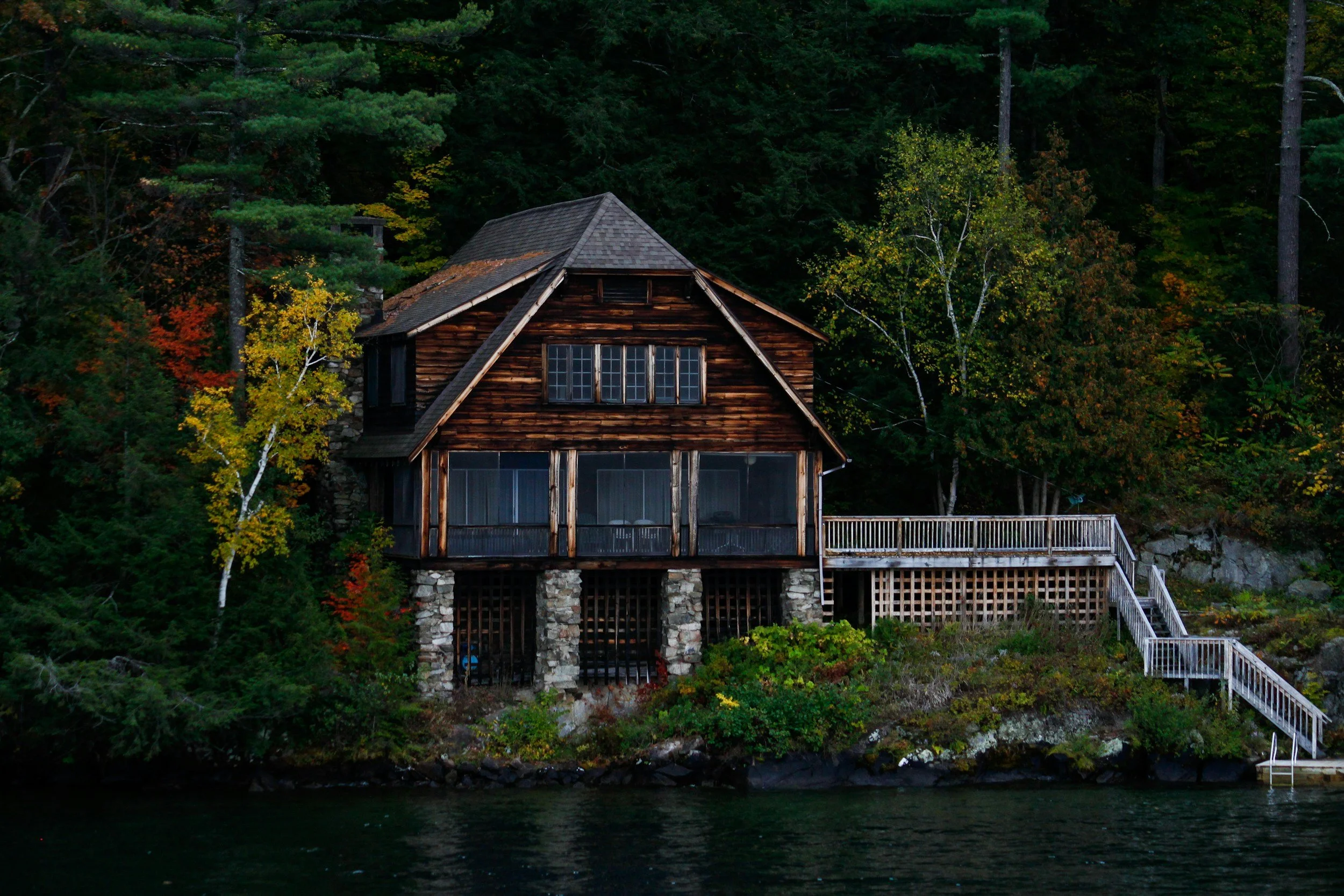
The entire state law protecting old lakefront cottages is four paragraphs long. I have read longer instructions on a bag of water softener salt.
That’s MCL 125.3208, the nonconforming-use section of the Michigan Zoning Enabling Act. Paragraph one says that if your use was lawful when the zoning ordinance passed, it may continue. Paragraph two hands everything else — restoration, reconstruction, extension — to your township, to decide “upon terms and conditions provided in the zoning ordinance.”
Read that again. The state does not tell you whether you can rebuild your cottage. It tells your township that it gets to decide. And up here, the township line is often a two-track through the woods.
“Grandfathered” Is Not a Word Anybody at the Township Actually Uses
Buyers say grandfathered. Ordinances say legal nonconforming, and the difference is not cosmetic.
Grandfathered sounds permanent, like the house earned tenure. Legal nonconforming means close to the opposite: the township is tolerating something it would never approve today, and that tolerance comes with conditions written into a document most owners have never opened.
A huge share of the good cottages on our inland lakes are legal nonconforming. Peninsula Township’s nonconformity article is anchored to June 5, 1972. Suttons Bay’s shoreline setback relief pivots on September 14, 1994. If the cottage went up before those dates and sits inside today’s setback, it’s fine — right up until something happens to it.
Three Townships, Three Different Answers, One Weekend of Driving
Here’s where it gets uncomfortable. I pulled the nonconformity chapters from three Northern Michigan townships a waterfront buyer might realistically shop in the same weekend.
Torch Lake Township (Antrim County) looks most generous on paper. Section 2.03 lets you reconstruct to the original configuration after fire, explosion, or other acts of God — but only “if completed within eighteen (18) months after the damage or destruction.” Completed. Not started. Eighteen months, in a market where you’re standing in line behind every other builder from Elk Rapids to Bellaire.
Suttons Bay Township (Leelanau County) skips percentages entirely. Section 21.5(D) defines total damage as the point where “the insurance coverage, if it existed, would pay the full amount insured.” Cross that line and you get one year to complete reconstruction, plus 90 days to resume use. The zoning administrator can extend it, but only for weather, a criminal investigation, an insurance dispute, or property held in probate.
Peninsula Township (Grand Traverse County) has no deadline and no percentage at all. Instead the zoning administrator must determine that the rebuild will be “substantially the same as the previous nonconforming structure,” and that it “shall not be detrimental to the health, safety, and welfare and that substantial justice is achieved.”
No deadline sounds like the best of the three. It’s also the only one where the answer rests on a person’s judgment instead of a number. That isn’t a knock on Peninsula — it’s just a different flavor of risk, and one worth knowing you’re accepting.
The Footprint Trap: You Get the Same Box Back
This surprises people more than the deadlines do.
Every one of these ordinances lets you rebuild the cottage you had, not the cottage you want. Torch Lake’s Section 4.04(C) permits replacement “provided such replacement utilizes the original structure footprint, does not increase the original usable floor area or volume.” Suttons Bay allows replacement “in the size, shape and footprint of the structure being replaced.”
So the 1,100-square-foot cottage with the low ceilings and the single bathroom comes back as an 1,100-square-foot cottage with low ceilings and a single bathroom. Want to add a half story to catch the water view? Torch Lake’s zoning board settled that in 2001 and clarified it in 2002: adding volume or square footage of living space inside the setbacks requires a dimensional variance.
A variance is a request, not a right. Anybody who calls it a formality has never sat through a zoning board of appeals meeting on a Tuesday night in February.
The Ambush Nobody Budgets For: The Septic Comes Along for the Ride
Buried in that same Torch Lake section is one sentence that costs real money. Before rebuilding, “the owner must have the sewage disposal system and water supply evaluated by the District Department Number Three” — the health department, in a phrasing that tells you exactly how old this language is.
A drainfield installed in 1968 twenty-some feet from the water was perfectly legal in 1968. It is not sailing through a modern health department review. So the fire that takes the cottage can take the septic system with it, and suddenly you’re siting a new drainfield on a small waterfront lot where the good ground was spoken for decades ago.
It’s the same soil math we walk through on vacant land in the perc test breakdown, except here you’ve already paid waterfront money for the parcel.
The Clause That Punishes an Empty Cottage
Torch Lake again, Section 4.02(E): “A legal nonconformity is lost by changing to conform to the ordinance or through vacancy, lack of operation or otherwise for twelve (12) or more successive calendar months.”
Closing the place up for the winter is not what this is aimed at — that’s seasonal use, not vacancy. But an inherited cottage nobody has opened in three summers while the family sorts things out? That’s precisely the scenario this language exists for.
Suttons Bay approaches it through an intent test that weighs disconnected utilities, disrepair, removed fixtures, forwarded mail, and a changed tax classification. If you’re on the cottage-committee end of a family property, learn this before the third summer, not after.
The Insurance Line Item That Quietly Fixes Half of This
A standard homeowners policy rebuilds what you had. It does not automatically cover the extra cost of complying with codes and ordinances that have changed since 1968 — the taller foundation, the current-code septic, the engineered stormwater.
That’s ordinance or law coverage, and it’s typically a modest annual add-on rather than a separate policy. On a legal nonconforming waterfront cottage it may be the highest-leverage line item in the entire file.
Ask your agent for the sublimit. Not whether you have the coverage — how many dollars of it. The cap is where these claims actually break.
Four Questions Before You Write the Offer on an Old Cottage
This is the short version we run with anyone shopping older waterfront:
Is it nonconforming, and how? Setback, lot width, height, coverage — or all four? Ask the zoning administrator directly, in writing. It’s a free phone call and they field it constantly.
What’s this township’s rebuild clock? Eighteen months, twelve months, or a judgment call. Then be honest about whether you could permit and build inside that window up here.
Can a septic be sited on this lot at all? Not “does it work now.” Can a new system go in today, under current isolation distances.
What’s my ordinance-or-law sublimit? In dollars.
Four questions. Maybe two hours of work. It’s the cheapest due diligence in Northern Michigan real estate and almost nobody does it.
None of This Means Don’t Buy the Cottage
Let me be clear, because this reads like a warning and it isn’t one.
Legal nonconforming cottages are structurally the best real estate we have. They sit where nothing new will ever be allowed to sit again. That scarcity is a real part of why Leelanau County’s average sale price climbed to $937,506 in the first half of 2026 — up more than 10% year over year — on 151 sales versus 130 in the same stretch of 2025.
Nobody is paying that for the drywall. They’re paying for a position current zoning would never permit twice.
Grand Traverse County went the other direction over the same six months: 571 sales against 652 a year ago, with the median still ticking up to $420,000. Fewer transactions, firmer prices on the right properties. That’s a market where a patient, well-prepared buyer has room to work.
The mistake isn’t buying the old cottage. The mistake is buying it while assuming the word “grandfathered” is doing more work than it actually does.
Send Me the Address First
Between Janel’s 25-plus years up here and a genuinely unreasonable number of hours spent reading township ordinances that badly needed an editor, this is the category of question we get asked least and should get asked most.
If you’re circling something older on the water — in Suttons Bay, on the Chain of Lakes, or anywhere in between — send me the address before you write the offer. I’ll pull that township’s nonconformity chapter and tell you what it actually says.
And if the appraisal side of an odd waterfront property is also on your mind, we’ve written about that too. You’re welcome to browse what’s currently on the market while you think about it — though on an old cottage, the ordinance matters more than the listing photos.
Taylor Brown, Realtor
(231) 360-1510
