Can You Get Insurance on a Northern Michigan Cottage With a Wood Stove?
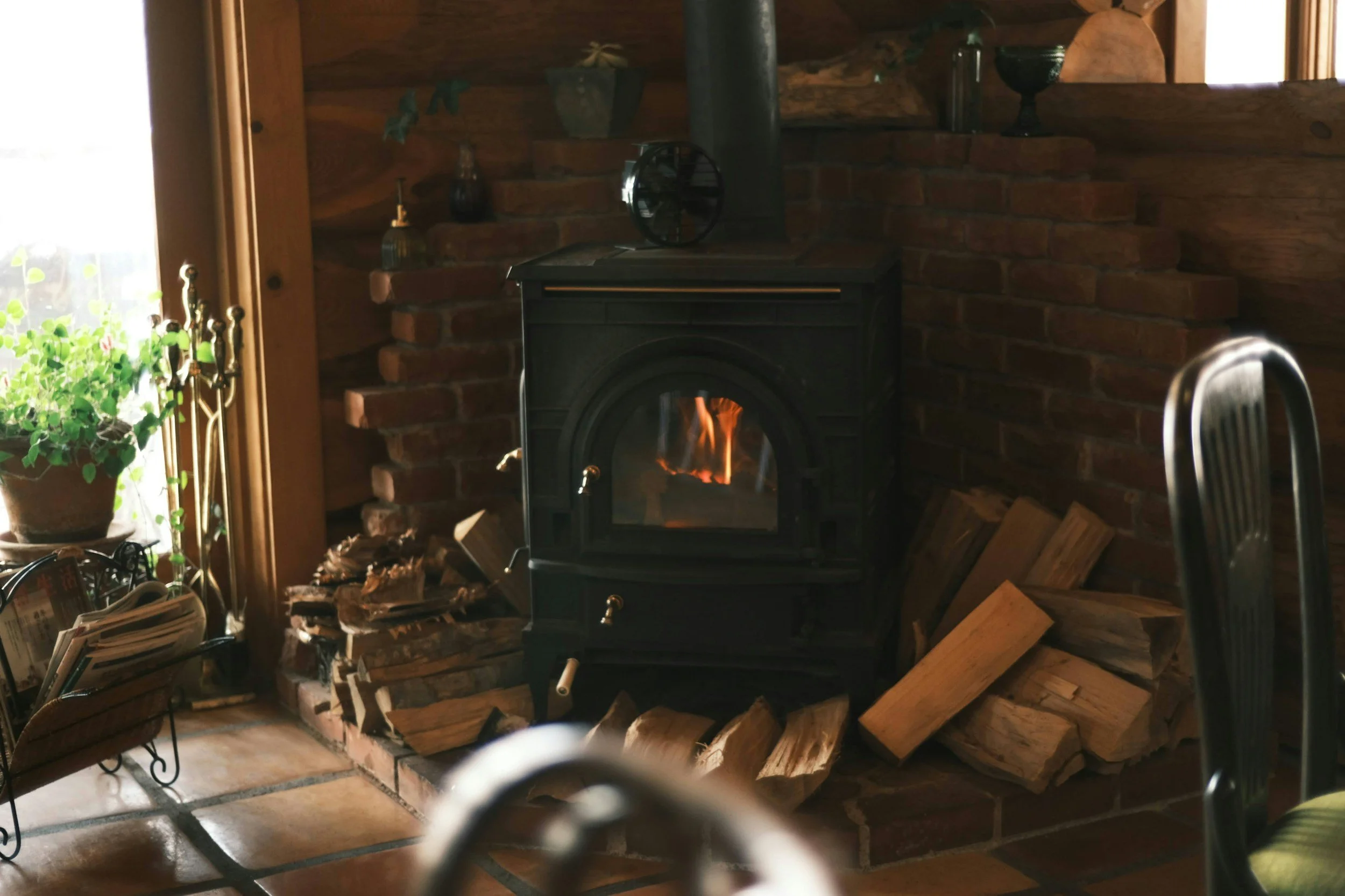
Thirty-six inches. That is how much room NFPA 211 wants between an unlisted wood stove and anything in the room that can burn, and a lot of the stoves sitting in cottages between Cedar and Central Lake are nowhere close to that.
Nobody thinks about it in July. In July the stove is charming, a cast iron box in the corner of a knotty pine living room, and it photographs beautifully.
Then an offer gets written in September, the lender asks for an insurance binder, and an underwriter somewhere asks the one question the listing never answered. Is that thing listed, and who installed it?
Listed, unlisted, and the 36-inch problem
A listed appliance has a tag on it, usually riveted to the back or tucked under the ash lip, carrying a UL or similar listing number and the manufacturer's own clearance distances. Those distances are almost always far smaller than 36 inches, because somebody paid a lab to test the thing. Six or eight inches to a side wall is normal on a modern stove with a rear heat shield.
An unlisted stove has no tag. Shop-built, barrel kit, a handsome old parlor stove somebody pulled out of a barn in Kalkaska. Without a tag there is no tested number, so the standard falls back to 36 inches, measured from the hot surface of the stove to the nearest combustible material. Proper ventilated shielding can cut that by up to roughly two thirds, which gets you down to about a foot, but the shielding has to be built correctly with a real air gap and continuous airflow behind it, and the measurement still starts at the stove and not at the face of the shield.
You see installs up here where somebody screwed a sheet of galvanized flat against the drywall and called it a heat shield, which does not shield much of anything and mostly just hands the heat to the wall.
Call the insurance agent first
This is the sequence I would change about how most people buy a cottage up here. The home inspection gets booked immediately, because it is the thing on the contract clock. The insurance quote happens later, once everybody already assumes the deal is fine.
Flip it.
Carriers are all over the map on wood heat. Most will write the policy and add a surcharge. Many will send out a wood stove supplement, which is a separate questionnaire that wants to know whether the unit is listed, who installed it, whether it was permitted, whether it is the primary heat source, how far it sits from the walls, and when the flue was last swept. Some carriers will not write an unlisted stove or an outdoor boiler at all, and they do not negotiate about it. Janel has watched underwriting tighten and loosen for 25 years, and right now it is tight for reasons that have nothing to do with wood.
Michigan home insurance was already getting harder and more expensive up here before you add a question mark about solid fuel heat. That is how a buyer ends up with one quote instead of four, at a premium that moves the monthly payment ten days before closing. And wood is rarely the whole heating story in these houses anyway, since most of them run on a propane tank in the yard, which has its own calendar.
What a home inspector will and won't do
A general home inspection is visual. The inspector looks at the chimney from the roof and from the room, notes what is obvious, and writes "recommend evaluation by a qualified specialist." I don't hold that against anybody. Running a camera up a flue is a different trade with different tools.
NFPA 211's own answer for a property sale is a Level 2 inspection, which means a camera scan of the flue interior, a look at the accessible chimney in the attic and the crawlspace and the basement, and a check on clearances to combustibles. It is the industry standard on a transfer. It is not Michigan law and nobody at the closing table will require it, so it happens when the buyer asks for it and otherwise it does not happen.
It runs a couple hundred dollars in this area, give or take. On an old chimney it is the best inspection money I know of, and a cracked clay liner is a bad thing to learn about in January.
If it were my money and the stove were unlisted with no paperwork behind it, I would rather it be gone before closing than take somebody's word about the clearances.
The permit, if there is one
Installing a solid fuel appliance is permitted work in Michigan, so there should be a record. The record is not always where people go looking for it. In Leelanau County, construction code enforcement runs through the county rather than the townships, at the Department of Building Safety on Government Center Drive in Suttons Bay, (231) 256-9806. Grand Traverse has its own office, and some Michigan jurisdictions are still enforced by the state. "I called the township and they had nothing" very often means somebody called the wrong building.
No permit does not prove an install is unsafe. Plenty of careful people did careful work without pulling one. But it does mean no inspector ever looked at it, and it means the carrier's questionnaire gets a blank where it wanted a yes.
Outdoor boilers are a township question
If there is an outdoor wood-fired boiler sitting in the side yard, read the zoning before you get attached to the place. Michigan publishes a model ordinance for outdoor and open burning that includes language for outdoor wood-fired boilers, and townships adopt from it however they like. The ones that do regulate them tend to set a minimum lot size and a setback from the nearest building. Two acres and 100 feet are numbers that show up in Michigan ordinances, but the specifics are entirely local, and so is whether there is an ordinance at all. A boiler that went in legally in 2009 can be a nonconforming use now, which changes whether you get to replace it when it rusts through.
I don't know what every township in Antrim or Kalkaska says about outdoor boilers and I'm not going to pretend otherwise. Call the zoning administrator. It takes ten minutes.
One more piece of timing, since it's September and people are already stacking wood along the county roads. If the plan was to buy the cottage and then put in a nice new stove, the math got worse this year. The federal 30% credit on qualifying wood and pellet stoves, capped at $2,000 a year, expired on December 31, 2025. It had been scheduled to run through 2032, and last year's budget law pulled the date forward. A new stove in 2026 is full retail.
Ask for the manual. Ask who put it in and when the flue was last swept. If all you get is a shrug, that's fine, that's most cottages up here, but build the Level 2 into your inspection window and get your insurance person on the phone in week one instead of week three.
If you're looking at something with a stove in the corner, which describes most of the good ones, I'm glad to help you sort out which wood stove is a feature and which one is a project. Our current listings are a decent place to start.
Taylor Brown, Realtor
Taylor@taylorbrownrealtor.com
