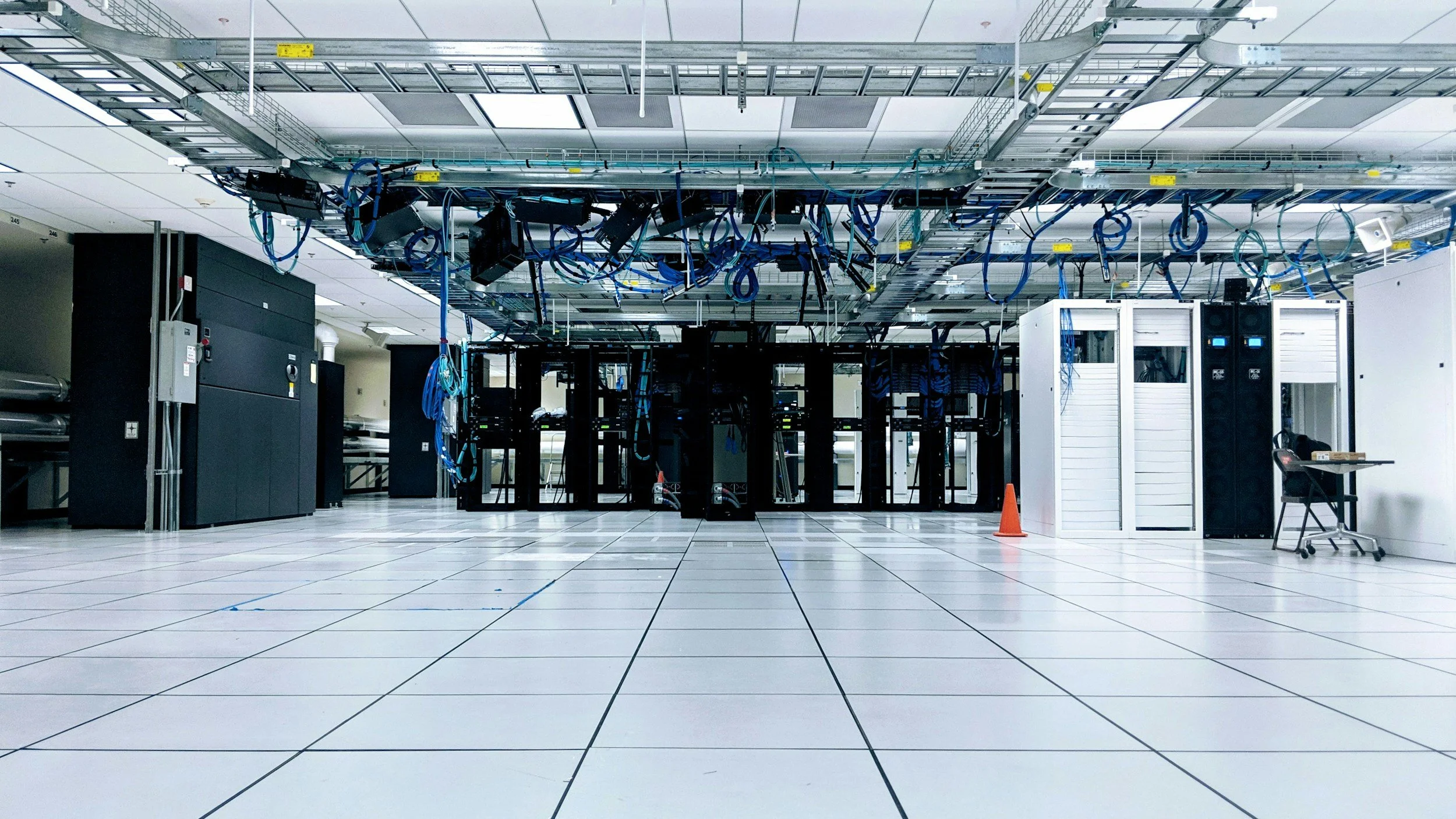
Hundreds of people packed Garfield Township Hall in July and gave ninety minutes of public comment, nearly all of it against data centers. The crowd size makes more sense once you know the zoning.
Under Garfield Township's ordinance as currently written, data centers and computer operations are a permitted use by right in both the I-G (General Industrial) and I-L (Limited Industrial) districts.
By right means no special use permit. No public hearing. No vote by anybody you elected. Submit a complete site plan that meets the standards already on the books, and staff approve it.
What's actually on the table
An Illinois developer, Cervenka Development Partners, submitted a site plan application for two industrial parcels totaling 3.45 acres at 2325 and 2357 Sybrandt Road, off Cass near the old Sara Lee plant. The Ticker obtained it through a FOIA request.
The application describes an adaptive reuse of the existing industrial building to house servers, network infrastructure, electrical distribution equipment, and battery backup. No expansion of the building footprint. No water line upgrade, because water isn't being used for cooling.
Township Planning Director John Sych says the application is incomplete — it's missing detailed engineering, lighting, and landscaping plans — and can't be considered for approval until it is. The developer wrote that those would come later, that the application was submitted solely to establish the proposed land use. Sych says that's not how the process works.
So this particular project isn't the emergency. The zoning is.
The pause button, and what it does and doesn't do
Here's the sequence, because the distinction matters and it got flattened in a lot of the coverage.
In July, planning commissioners recommended a zoning amendment that creates a procedure for temporary moratoriums on any land use. Trustees adopted it at an August 11 public hearing. The next night, planning commissioners took up the written findings — the justification for actually pointing that tool at data centers.
The amendment by itself froze nothing. It built the lever. Once used, an initial moratorium runs up to twelve months with a possible six-month extension, for eighteen months total to rewrite the ordinance.
Staff put four concerns on the record: energy consumption, economic benefits arriving lower than promised, water and sewer impacts, and noise.
The water and sewer problem is specific to Garfield
Deputy Planning Director Stephen Hannon flagged an added layer of complexity that most people outside the township don't think about. Garfield Township doesn't own its water and sewer. It buys both from the City of Traverse City.
That's a real constraint on any large new load, and it's the same structural issue underneath the Acme water system study that nobody paid attention to while everyone argued about the Meijer.
The pattern up here is consistent enough to be a rule: the growth question is almost never whether there's land. It's whether there's capacity, and who controls it.
Noise turned out to be the bigger issue
Hannon told commissioners noise is a bigger concern than the township initially thought, pointing to communities elsewhere in Michigan where the constant hum from a data center has drawn pushback from neighbors.
That's the part worth sitting with if you own or are buying near industrial ground. It isn't a construction-season problem that ends. It's a 24/7 mechanical baseline, and it's not something buyers audition for on a Saturday showing in August with the windows closed.
To be fair to the specific proposal on Sybrandt: no water cooling, and the application commits to architectural sound and sight screening around rooftop mechanical equipment. A small adaptive reuse is a genuinely different animal than a hyperscale campus.
Trustee Molly Agostinelli, who also sits on the planning commission, said she doesn't believe a hyperscale project could land in Garfield at all for lack of available land. Her concern is the medium-sized ones. Hannon's response was the honest one: even the small data centers still have impacts.
Why this is landing in Michigan right now
It isn't a coincidence, and it isn't local.
Michigan's enterprise data center sales and use tax exemption took effect in April 2025 under Public Acts 181 and 207 of 2024. It strips the state's 6% sales and use tax off qualifying data center construction and equipment, and it runs through 2050.
The thresholds are real — $250 million in capital investment, at least 30 full-time jobs paying 150% or more of the regional median wage, green building certification, and 90% of electricity from renewable sources. But the effect is the one every state that has passed a version of this has seen: adopt the exemption, get the applications.
Northern Michigan is now on that map. Garfield is just the first township here to have the argument out loud.
The Industrial Edge Test
Run this before you write the offer on anything within earshot of a non-residential district. It takes about twenty minutes.
1. Find the nearest non-residential zoning district and measure the distance. Not the nearest ugly building — the nearest district line. Grand Traverse County unveiled a countywide zoning atlas that makes this dramatically easier than it used to be.
2. Ask what's allowed there by right. This is the whole ballgame, and almost nobody asks it. Current use tells you nothing about future use. By-right uses arrive without a hearing, without notice, and without a vote.
3. Ask whether the township has a moratorium procedure and an active master plan or ordinance rewrite. A township in the middle of rewriting its zoning is a township that has noticed something. That's useful information, and it's public.
4. Find the substation. Large electrical loads follow existing transmission and distribution infrastructure. TCLP confirmed the Sybrandt parcels sit near its Cass Road substation and that it had spoken with the developer as a speculative customer. That proximity is why those two parcels were interesting in the first place.
What I'd actually tell a buyer
Don't panic-price this. One incomplete application on 3.45 acres of ground that has been industrial for decades is not a value event for houses in Garfield Township or greater Traverse City. Anyone telling you otherwise is selling something.
But "it's zoned industrial across the road and it's been a warehouse forever" is a different sentence than "it will be a warehouse forever," and buyers collapse those two constantly. Working this market, that's the assumption I'd most like to talk people out of.
The people who get caught in a zoning shift are almost never the ones who read about it in advance. They're the ones who assumed current use equals future use, because it had for thirty years, and nobody handed them a reason to check.
Twenty minutes on a zoning map is cheap. So is asking.
If you're looking at something near an industrial edge, or you just want to know what's actually allowed next door to a house you're considering, send me the address. I'll pull the zoning and tell you straight — including when the answer is "this is fine, buy the house." You can also see what we've got moving right now on our current listings.
Status as of August 18, 2026: Garfield Township has adopted the moratorium procedure. A data-center-specific moratorium had not yet been enacted. This one is moving fast enough that it's worth checking the township agenda rather than trusting a blog post, including this one.
Taylor Brown, Realtor
Taylor@taylorbrownrealtor.com
