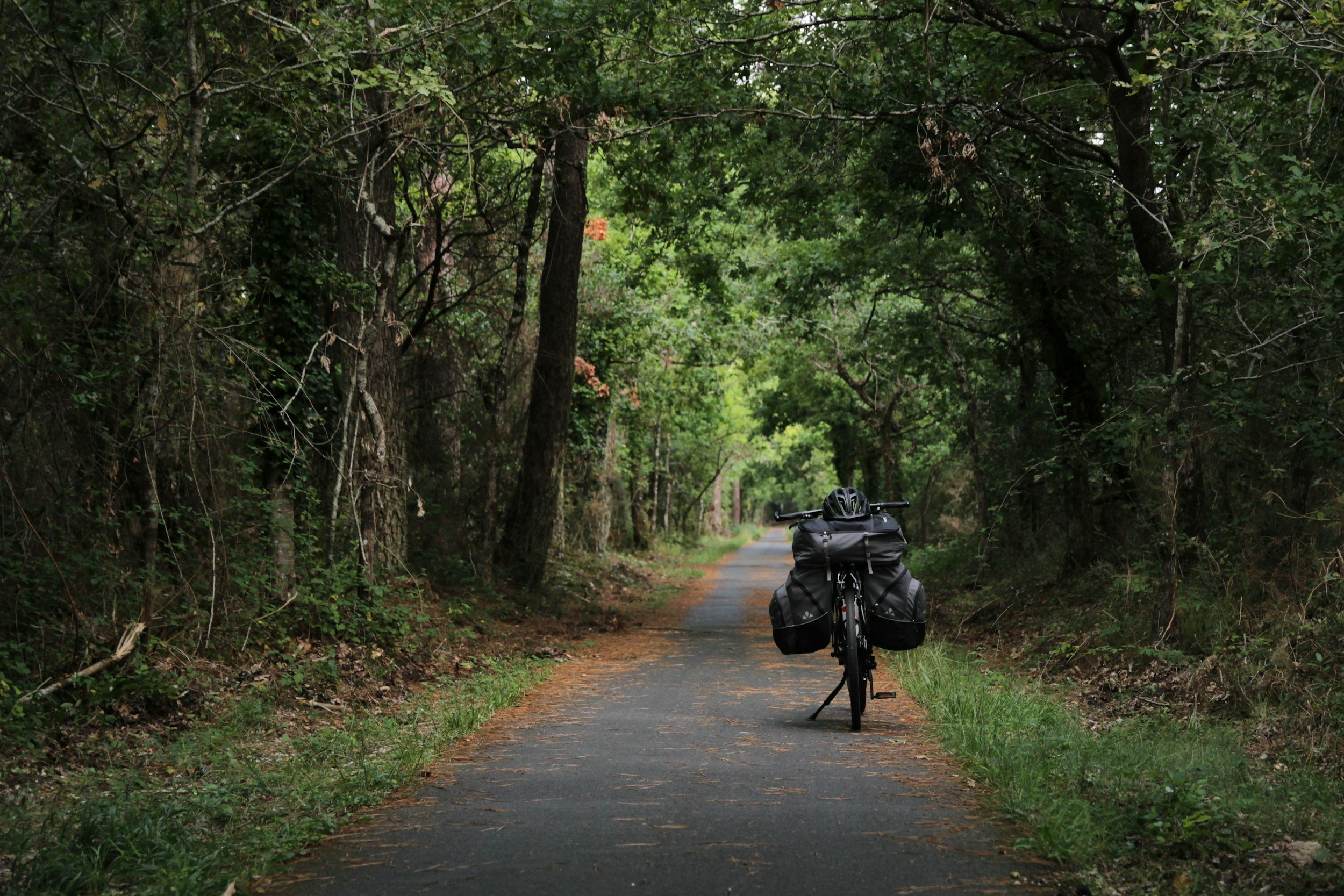
In May, the Village of Elk Rapids landed a $2 million conditional commitment from MDOT to pave 1.6 miles between South Bayshore Drive and Townline Road. That's Phase I of the Nakwema Trailway — eventually 45-plus miles connecting Traverse City to Charlevoix, at a projected $15 million.
It's great news. It's also about to teach a few hundred Antrim County property owners something strange about their back lot line.
The strip behind the house is not like other land
Nearly every rail-trail up here is a repurposed railroad corridor. The Leelanau Trail is the old rail line running fifteen miles from Traverse City up to Suttons Bay. The Betsie Valley Trail is the former Ann Arbor Railroad, Frankfort east toward Thompsonville. Same story on most of the TART network.
Here's the part nobody puts in a listing: railroads in the 1800s acquired that ground two very different ways. Some bought it outright in fee simple. Many took only a "right of way" — an easement to run a railroad, and nothing more.
From the outside, those two look identical. A hundred and fifty years later, they are not remotely the same thing.
If the railroad owned the corridor in fee, it's a normal parcel, the trail group owns it, and there's nothing to discuss. If the railroad held only an easement, then when railroad use ends that easement dies — and the ground underneath belongs to the adjoining landowner, often all the way to the old centerline.
The 1873 deed that still decides this
Michigan's leading case on this is DNR v. Carmody-Lahti Real Estate, decided by the Michigan Supreme Court in 2005. In 1873, Quincy Mining Company conveyed what the deed called a "right of way" to the Mineral Range Railroad.
More than a century later the DNR, standing in the railroad's shoes, argued it owned that corridor outright and could run a snowmobile and recreation trail on it. The Court disagreed on every point that mattered.
The 1873 deed conveyed an easement, not fee. The easement was limited to railroad purposes. And the railroad's successor had abandoned it.
That is not an Upper Peninsula curiosity. The same boilerplate deed language got used across Michigan during the same decades — including on the corridors that now carry bikes through Leelanau and Benzie counties.
Railbanking: the federal move that freezes the whole question
Then Congress complicated it. Under the National Trails System Act, a corridor headed for abandonment can instead be "railbanked" — legally preserved for possible future rail service, with interim use as a trail.
The elegance, from a trail builder's perspective, is that abandonment never legally occurs. And if abandonment never occurs, reversion to the adjoining owner never triggers. The strip stays a corridor indefinitely.
The flip side: if your land would have come back to you and federal railbanking is the only reason it didn't, courts have treated that as a Fifth Amendment taking — a claim against the United States, filed in the Court of Federal Claims, generally within six years. Most affected owners never hear the word "railbanking" until that window has quietly closed.
I'm a Realtor, not an attorney, and this is exactly the kind of question where a real estate lawyer and a good title company earn every dollar. But you have to know to ask.
What this actually changes at the closing table
Forget the constitutional theory for a second. Here's how corridor ownership shows up in an ordinary Northern Michigan transaction.
Taxes. Sometimes the adjoining owner is still on the tax roll for ground they can't use. If the corridor has no separate parcel number at the county equalization department, that's a clue worth chasing.
What you can do at the edge. Fences, plantings, a shed, a driveway that crosses the corridor to reach a back parcel — all of that runs through the trail manager, not just your township.
Winter. The Betsie Valley Trail's eastern section is open to snowmobiles December 1 through March 31. The first six miles out of Frankfort are paved and quiet. "Paved path forty feet off the porch" and "snowmobile corridor forty feet off the porch" are two completely different houses.
Legal descriptions. Older deeds up here still describe boundaries running to a railroad centerline that hasn't seen a train since the Ford administration. Surveyors love this. Buyers usually don't.
The fights are already on the record
This isn't hypothetical drama. It's in the court files. The Leelanau Trail Association formed in 1994 to buy fifteen miles of corridor from Traverse City to Suttons Bay, and purchased most of the right of way in 1995.
Adjacent-owner opposition was immediate and litigious, and the related railroad-abandonment fight, RLTD Railway Corp. v. Leelanau County, went all the way to the Sixth Circuit in 1999.
Over on the Betsie Valley Trail, the stretch along Crystal Lake operates under a long-standing agreement with adjacent landowners containing special provisions, and the Crystal Lake Property Rights Association holds a seat on the trail's management council. That's why that particular segment looks and behaves differently from the rest.
If you buy along there, you inherit that arrangement. It doesn't reset because the house changed hands.
The Corridor Test
Three questions, before you write the offer on anything that touches a rail-trail in Grand Traverse, Leelanau, Benzie or Antrim County.
1. Fee or easement? Ask the title company to trace the original conveyance, not just the last recorded deed. The phrase "right of way" in a 19th-century instrument is a flag, not a formality.
2. Who's on the tax roll for the strip? Pull the parcel map. A corridor with no parcel number of its own is telling you something about who the assessor thinks owns it.
3. What's allowed on it in winter, and who decides? Motorized or non-motorized, who manages it, and whether an owners' agreement governs your segment. Ask before you fall in love with the summer version.
And a bonus question for the Nakwema corridor specifically: is the segment behind this house built, funded, or just drawn on a map? Those are three very different timelines, and the Elk Rapids phase is the one with money attached.
The honest verdict
Don't read any of this as "avoid the trail." Trail frontage is one of the better amenities in this market, full stop. A paved connection into downtown Traverse City or north toward Suttons Bay is worth real money, it makes a house easier to sell, and it isn't going anywhere.
We see this pattern a lot up here: the amenity is genuine, and the paperwork behind it is a hundred years older than anyone assumes. Over twenty-five years in this market, Janel has watched more than one "great trail access" turn into a title conversation nobody scheduled.
The point isn't that the trail is a problem. The point is that "on the trail" is a legal fact, not just a lifestyle bullet — and you should know which version you bought.
So here's the one I'd actually put to you: would you rather back up to a paved, busy, well-used trail — or to a wooded corridor nobody's touched in forty years? Up here you can genuinely have either, and they don't price the same.
If you're looking at something along the TART, the Leelanau Trail, the Betsie Valley Trail, or anywhere in the Nakwema corridor, I'm happy to pull the parcel map and take a look before you get emotionally attached. It's a ten-minute conversation that occasionally saves a very long one. You can also just browse what's currently on the market and send me an address.
Taylor Brown, Realtor
Taylor@taylorbrownrealtor.com
