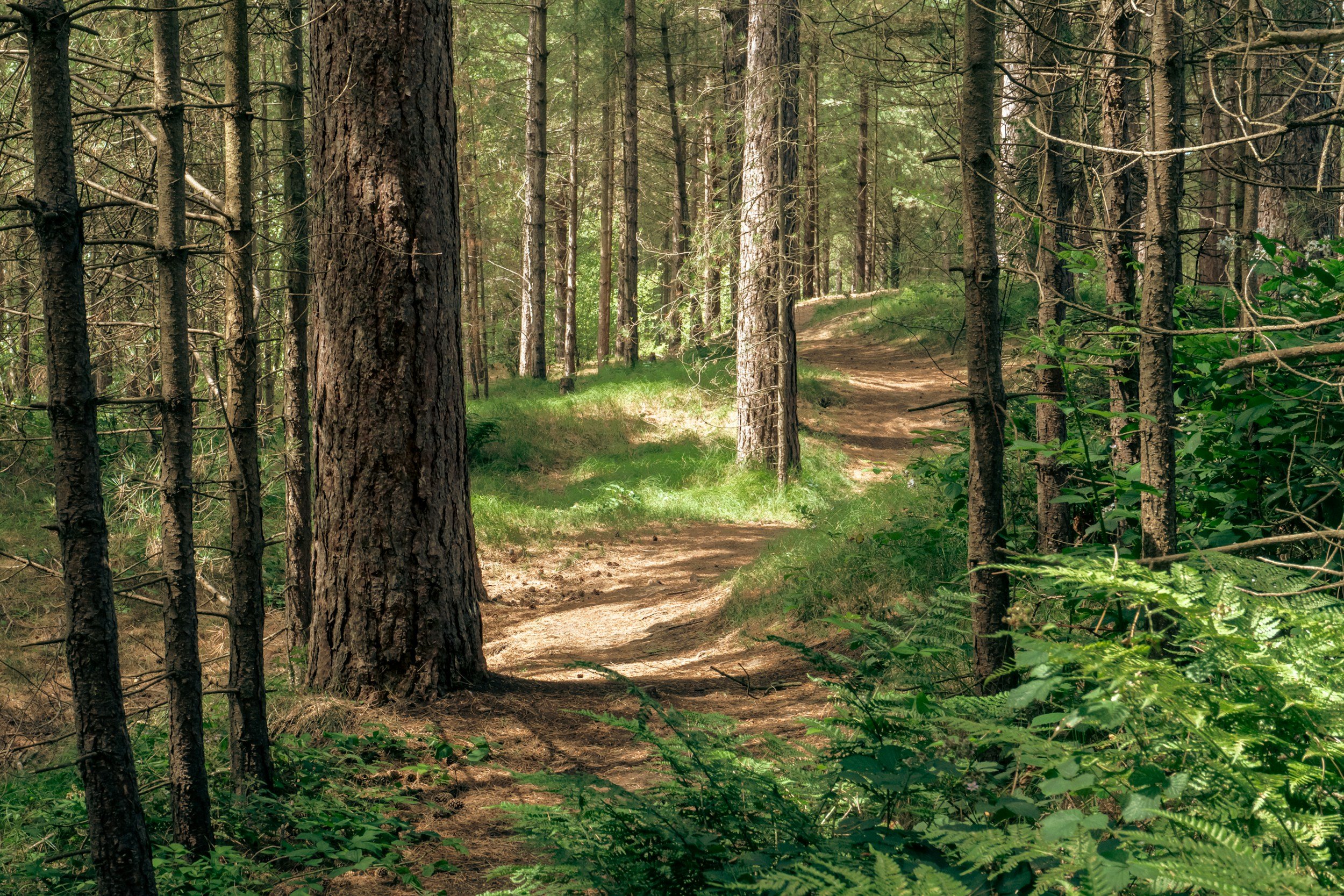
There is privately owned land in Kalkaska County where the owner cannot legally post a “No Trespassing” sign. Not chooses not to. Cannot. A stranger can walk onto it in November with a rifle and a deer tag, and the owner has no say in it.
That is not a loophole or a squatter’s-rights curiosity. It is Part 511 of Michigan’s Natural Resources and Environmental Protection Act, it covers more than 2.2 million private acres statewide, and the DNR publishes a Commercial Forest parcel summary for every county in Michigan — Grand Traverse, Leelanau, Antrim, Benzie and Kalkaska all included.
Here’s the part that catches buyers: the enrollment travels with the dirt, not the owner. You can buy it without ever hearing the words.
The $1.35 Trade
The Commercial Forest program is a straight bargain the state offers landowners. Keep your forty-plus acres in working timber, let the public walk in to hunt and fish, and you stop paying regular property taxes on it entirely.
Instead you pay a specific tax. For tax years 2022 through 2026 that rate is $1.35 per acre, per year — it climbs a nickel every five years. On 80 acres, that is a $108 annual tax bill.
Read that again if you own land up here. A hundred and eight dollars.
What the Public Actually Gets
The access right is narrower than most people assume, and I’d rather you know the exact edges than guess at them.
The public gets foot access, for hunting, fishing, and trapping. That’s the whole list. No permission needed, no knock on the door.
What the public does not get: camping, ORVs, target shooting, cutting shooting lanes, building blinds, or leaving a tree stand behind. Those remain trespass, and a person doing them can be held criminally or civilly liable — the underlying land is still private property with normal private property rights.
And a fence or a gate doesn’t change it. The DNR is explicit that a gated parcel is still open to foot access for hunting and fishing. The owner can close it during an active logging operation for safety. That’s it.
The Restrictions Nobody Reads Until After Closing
This is where a Commercial Forest parcel stops being a clever tax play and starts being a genuinely different asset than the 40 acres next door.
You cannot build on it. Not a cabin, not a residence, not a resort, not developed recreation. The DNR’s own summary lists what’s prohibited: buildings and improvements including trailers, motor homes, permanent hunting blinds, and utilities. If your plan for the property involves a driveway, a well, and a place to sleep, this program is not for you.
You cannot post it. “No Trespassing” and “Private Property” signs aren’t allowed, unless the private property sign also states the land is open to the public for hunting and fishing. Think about what that means for someone who bought acreage specifically for solitude.
You cannot lease the hunting rights. Landowners can’t take consideration for an agreement affecting the land — a lease, an easement, a trail agreement — and any such agreement has to go to the DNR for review at least 30 days beforehand.
All harvesting runs through an approved plan. You need a forest management plan written by a registered forester, and you have to notify the DNR in writing 10 days before cutting or removing forest products. Cut more than $2,500 worth in violation of Part 511 and you’re not looking at a fine — you’re looking at a felony.
The 90-Day Clock Most Buyers Blow Through
If you buy enrolled land, you inherit the obligation, and the meter is already running.
Any document transferring title to Commercial Forest land is supposed to state that the land is subject to Part 511. But the practical deadline is this: a new owner must be compliant — meaning submit an active forest management plan to the DNR, or a contract for one to be written — within 90 days of the date of the deed or land contract.
Ninety days, from a program you may not have known existed at the showing. This is exactly the sort of thing that gets buried in a land transaction, right alongside the perc test that decides whether “buildable” means anything and the private road agreement that decides whether you can reach the place in February.
Want out? You apply to withdraw, pay an application fee, and pay a withdrawal penalty the DNR calculates under the Part 511 formula, remitted to your township treasurer. Withdrawals of less than 40 acres may require township split approval and a survey. Plan on roughly twelve weeks of processing, not twelve days.
The Other Forest Program — And Michigan’s Rarest Tax Break
Now the good news, and it’s better than most buyers up here realize.
Michigan runs a second, entirely separate forest program: the Qualified Forest Program, administered by MDARD rather than the DNR. Twenty-acre minimum. Land does not have to be open to the public. Structures are allowed — you just keep paying school operating millage on the value of the buildings.
The benefit is an exemption from up to 18 mills of local school operating tax on the land value, offset by an annual fee equal to 2 mills of taxable value that funds the Private Forestland Enhancement Fund.
But that’s not the interesting part. The interesting part is the uncapping.
We’ve written before about Michigan’s uncap rule — the pop-up that turns a seller’s $3,800 tax bill into your $6,000 one the January after you close. It is the most common bad surprise in Northern Michigan real estate, and there are very few ways around it.
Here’s one almost nobody uses: if you purchase forested land already enrolled in the Qualified Forest Program and execute a Qualified Forest Taxable Value Affidavit, your taxable value stays capped at the previous owner’s level.
Not reduced. Not uncapped at all. On a long-held Northern Michigan parcel with decades of capped value underneath it, that is a very large number.
The Recapture That Doubles
Nothing up here is free, and this one has teeth.
If Qualified Forest land is converted or comes out of the program, the owner files a rescission and pays a recapture tax: taxable value × the school operating mills (less the 2-mill equivalent fee) × the number of years the property was exempt, capped at seven years.
And if no harvest was ever conducted on the property, that figure is multiplied by two.
There’s a related trap: if the owner doesn’t complete the forest practices and harvests within six years of the first year specified in the management plan, the exemption goes away and recapture applies as though it had never been granted.
Who pays it? Whoever owns the parcel when it comes out — which could be the seller before closing or you, after. Michigan law requires a Qualified Forest owner to inform a prospective buyer that the property is subject to recapture, but “required to disclose” and “clearly explained at the showing” are different animals. The purchase agreement should say plainly who pays.
The Forty-Acre Test
Four questions, in order, any time you’re looking at Northern Michigan acreage larger than a building lot. Run them before you write the offer, not after inspection.
1. Is this parcel enrolled in anything? Ask the listing agent directly, then verify against the tax bill. A specific tax of roughly $1.35 an acre instead of a normal ad valorem bill is the tell for Commercial Forest. An oddly low bill with an 18-mill school exemption is the tell for Qualified Forest.
2. Can I do what I came here to do? If the plan is a cabin, a pole barn, a well, or a permanent blind, Commercial Forest kills it outright. Be honest with yourself before you fall in love with the aspen.
3. What’s the exit number? Get the withdrawal penalty or the recapture figure in writing before you’re under contract, and settle in the purchase agreement who’s paying it. On the Qualified Forest side, specifically ask whether a harvest has ever been conducted — that single fact doubles the number.
4. What’s the clock? Ninety days from deed for Commercial Forest compliance. And if you’re going the Qualified Forest route on land that isn’t enrolled yet, applications are due September 1 for the following tax year — which, as of today, is four weeks out.
Who Each One Is Actually For
Commercial Forest is for a working timber owner with real acreage who genuinely does not care about exclusivity — someone whose plan is a managed harvest rotation, not a deer camp. In our five counties that’s a narrower buyer than the tax number makes it sound.
Qualified Forest is a much wider fit. Twenty acres, no public access, structures allowed, and that taxable value affidavit on an inherited-value parcel. If you’re buying wooded acreage up here in any quantity, it’s worth a conversation with a qualified forester before September 1 rather than after.
And if you’re the seller of enrolled land? Say so early and say so loudly. The buyer finds out either way. Finding out at the closing table is how deals die.
So — 80 acres, no cabin ever, strangers can hunt it, and the tax bill is $108 a year. Would you take that trade? Some people up here absolutely would, and they’re not wrong.
If you’re looking at land in Grand Traverse, Leelanau, Antrim, Benzie or Kalkaska County and the tax bill looks strange, send it over. Working in this market you pick up on which parcels come with a rulebook attached, and Janel has watched enough of these cycles to know which questions save a deal versus which ones just slow it down. Happy to look at a tax bill with you — no obligation, no pitch. You can also browse what we currently have listed.
Taylor Brown, Realtor
Taylor@taylorbrownrealtor.com
