Written in March 2026. The market numbers below are from that month and have moved since, so ask us for today's.
A $120 million airport expansion doesn't just mean shorter TSA lines. It means more direct flights, more out-of-state buyers with carry-on luggage and pre-approval letters, and a fundamental shift in who's shopping for homes in Northern Michigan.
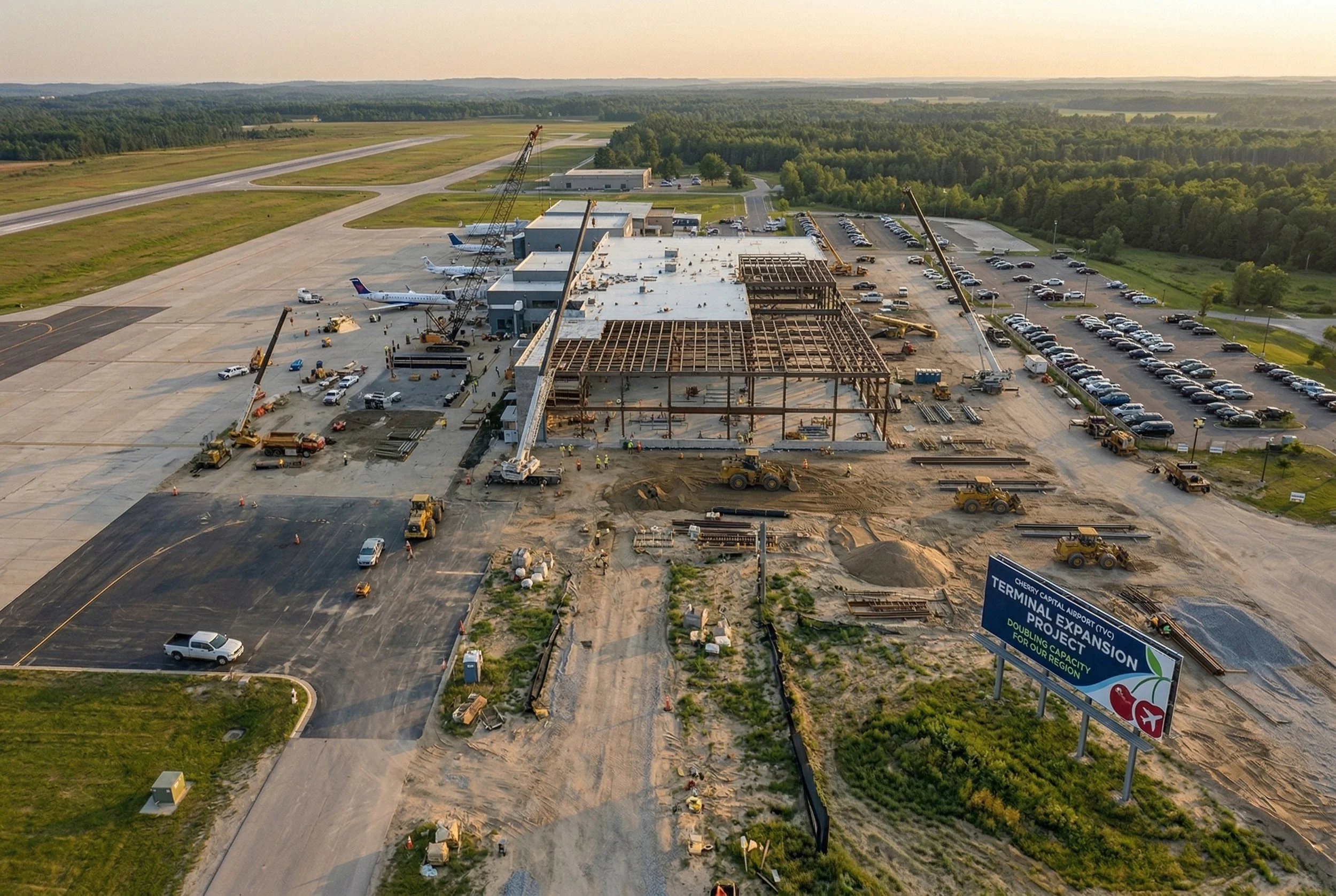
Cherry Capital Airport's "Gates to the Future" project breaks ground in spring 2026. By 2028, TVC will have nearly doubled its gate capacity — from six to ten or eleven. That's not a facelift. That's a completely different airport, and it's going to ripple through our real estate market in ways most people aren't thinking about yet.
The Numbers Behind the Runway
Here's what we're looking at: $120 million in total project cost, with roughly half covered by federal grants and infrastructure funding. The Northwest Regional Airport Authority is bonding the other $60 million. Construction kicks off in April and is targeted for completion in 2028.
The expansion adds over 100,000 square feet of passenger space, four new gates immediately, and a fifth gate planned for late 2028 or 2029. There's also a relocated security checkpoint, expanded baggage handling, new concession areas, and more restrooms. (The restroom thing might sound boring, but anyone who's flown out of TVC on a Friday afternoon in July knows exactly why that matters.)
TVC is already Michigan's third-busiest airport. Since 2019, it's added year-round and seasonal flights to cities across Florida and Arizona, plus increased service to Atlanta, Dallas/Fort Worth, Denver, Houston, and Washington. The expansion isn't speculative — it's catching up to demand that's already here.
Why This Is a Real Estate Story, Not Just a Travel Story
There's a direct line between airport accessibility and home prices, and we see it play out constantly in our market. Northern Michigan crossed a threshold around 2021 when it stopped being a regional getaway and became a national destination. Buyers started showing up from Texas, California, Colorado, Arizona, Wyoming, and Washington — and the common thread wasn't just remote work or pandemic restlessness. It was the fact that you could get here on a direct flight.
That shift showed up immediately in the luxury market. In 2025, the three-county area saw $227 million in gross sales of homes priced at $1 million-plus, up from $204 million in 2023. Waterfront sales over $2 million hit an all-time high. When a buyer in Dallas can land at TVC in three and a half hours and be standing on a dock in Suttons Bay before dinner, the purchase psychology changes entirely. It stops being a "vacation property I'll visit twice a year" and starts being a legitimate second home.
More gates means more flights. More flights means more frequency and more cities connected directly to Traverse City. And every new direct route effectively shrinks the distance between Northern Michigan and another metro area full of potential buyers.
The 30-Mile Radius Effect
Not every neighborhood benefits equally from airport proximity. In our experience working across Grand Traverse, Leelanau, and Antrim counties, the properties that benefit most from improved air access are the ones within about a 30-minute drive of TVC.
That radius captures Traverse City proper, Suttons Bay, Elk Rapids, Old Mission Peninsula, Williamsburg, Acme, and the northern stretches of the bay. These are the areas where an out-of-state buyer can fly in Friday evening and be at their property within half an hour — no long drives on two-lane roads, no navigating M-22 in the dark.
Further out — think Glen Arbor, Frankfort, or Bellaire — the airport expansion still helps, but the premium it adds is more muted. Those areas sell on the strength of their specific appeal (Sleeping Bear Dunes, Crystal Lake, the Chain of Lakes) rather than pure convenience. The airport makes the trip possible, but it's not the deciding factor.
The sweet spot as of March 2026? Properties in the $500K–$900K range within that 30-minute radius. That's where the expanded airport access overlaps with the price point most out-of-state second-home buyers are targeting. Grand Traverse County's median sale price came in at $405,223 in 2025, with total residential sales volume reaching nearly $749 million across 1,442 transactions — a 9% jump in units sold from the prior year, even as prices softened slightly.
The Price Correction Nobody Wants to Talk About
Here's where I'll be direct, because I think it matters: the airport expansion is bullish for Northern Michigan real estate long-term, but it's landing (pun intended) at an interesting moment.
After years of aggressive appreciation, Grand Traverse County saw its median sale price dip about 3.5% in 2025 compared to 2024. The average sale price also slid about 1.6%. That's not a crash — total sales volume still grew over 7% — but it signals that the pandemic-era pricing frenzy has cooled. Some sellers are still listing at 2022 prices and wondering why they're sitting. The market is finding its footing.
So the airport expansion creates a kind of tug-of-war: more accessibility and more demand from out-of-state buyers on one side, and a local market that's gently correcting after years of running hot on the other. My read? The expansion puts a floor under prices in the most accessible areas while the outer edges of the market continue to normalize. If you're within that 30-minute TVC radius and your property is well-maintained, well-priced, and well-marketed, you're going to benefit.
What This Means If You're Buying
If you're an out-of-state buyer eyeing Northern Michigan, the next two years are actually a compelling window. You've got a market that's slightly more reasonable than it was in 2022-2023, plus an airport that's about to get significantly better. The construction period (2026-2028) is your friend — things will be a little chaotic at TVC during the build, which might cool some casual interest, while the long-term fundamentals keep strengthening.
Think about it this way: you want to buy the house before the airport expansion is done, not after. By 2028, when those new gates are operational and TVC is running more direct flights to more cities, the convenience premium will be fully priced in. As of March 2026, it's still catching up.
What This Means If You're Selling
If you own property within that 30-minute radius of TVC and you've been thinking about selling, pay attention to the timeline. The spring and summer of 2026 are solid — inventory is still tight, buyer demand is healthy, and the airport expansion story adds a compelling forward-looking narrative to your listing. Buyers don't just buy what a place is today. They buy what it's becoming.
Make sure your agent is marketing to out-of-state buyers, not just locals. The whole point of the airport expansion is that Northern Michigan's buyer pool is getting bigger and more geographically diverse. If your listing photos only show up on the local MLS and a couple of Michigan-focused sites, you're missing the point.
The Bigger Picture
I think the airport expansion is one of those slow-moving, structural changes that reshapes a market over a decade, not a quarter. It's not going to double your home value overnight. But it will steadily increase the number of people who can easily get to Northern Michigan, which steadily increases demand, which steadily supports prices.
Combined with everything else happening — the downtown Traverse City investment, the waterfront market strength, the continued appeal of this area as a place people actually want to live — the airport expansion is another piece of the puzzle that makes Northern Michigan feel less like a sleepy vacation market and more like a real, nationally relevant destination.
That's exciting. And if you're smart about timing, it's actionable.
If you've got questions about how the airport expansion might affect your specific property or neighborhood — or you're an out-of-state buyer trying to figure out where to look — reach out anytime. This is the kind of stuff we talk about every day.
Taylor Brown, Realtor
(231) 360-1510
@listwiththebrowns
