A Creek You Can Step Across Pulls 400 Feet of Your Lot Into State Zoning. On the Betsie, That Caps Your Rental at Three Bedrooms.
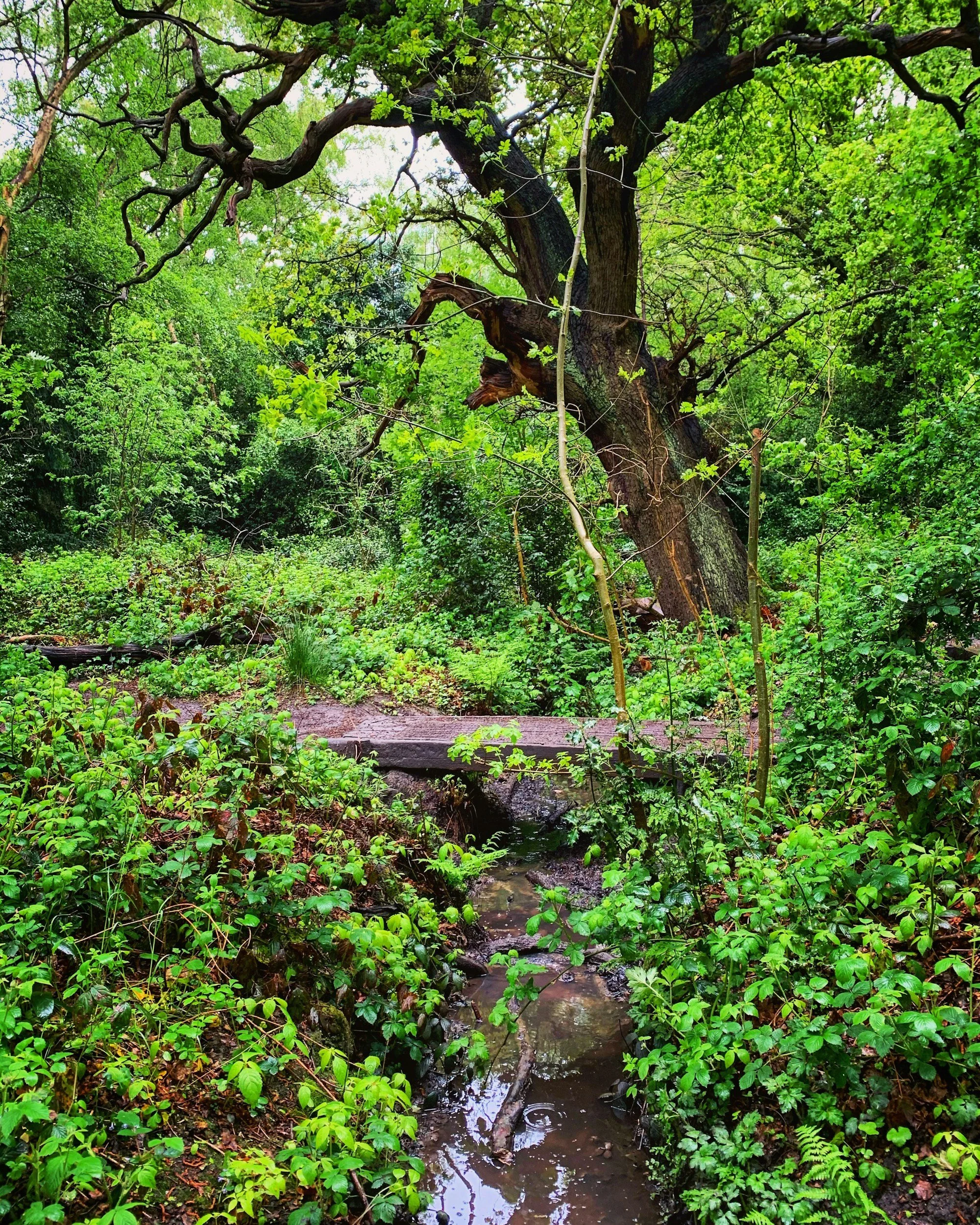
Dair Creek, in Benzie County, is the kind of water you step across in hiking boots without soaking your socks.
It is also a designated tributary of the Betsie River. Which means Michigan’s zoning authority reaches 400 feet back from both of its banks, and has since June 11, 1977.
That date does not appear on any listing I have ever read.
Sixteen rivers, and four of them are ours
Michigan runs a program called Natural Rivers. Sixteen river systems are designated statewide, and the designation covers the mainstream plus most of the tributaries.
Four of them are in our backyard. The Jordan came first, in 1972. The Betsie followed in 1973, the Boardman-Ottaway in 1976, and the Upper Manistee in 2003.
That is not a small footprint. The Betsie system alone is about 93 linear miles of stream. The Boardman-Ottaway runs roughly 130. The Jordan’s mainstream is 33 miles, from northwestern Antrim County down to the South Arm at East Jordan.
Every one of those systems carries a natural river district that extends 400 feet from the river’s edge on each side. Nearly all construction, earth moving, and placement of structures inside that band is regulated.
Here is the part that gets people: you do not need river frontage to be in the district. If a designated creek clips the back corner of the parcel, you are in it.
The numbers change by river, and they are not small
This is where it stops being abstract. The state publishes the standards for private lands, and they vary river to river.
Betsie: 200-foot building setback from the ordinary high water mark on the mainstream (100 feet on the Little Betsie and Dair Creek), 200-foot minimum lot width, a 50-foot natural vegetation strip, and a septic drain field that has to sit 150 feet off the water.
Jordan: 200-foot setback, 150-foot minimum lot width, a 100-foot vegetation strip, and a 200-foot septic setback. That is the strictest septic standard of any designated river in the Lower Peninsula.
Boardman-Ottaway: 150 feet on the mainstream and 100 on tributaries, 200-foot lot width, a 75/50-foot vegetation strip, and a 100-foot septic setback.
Upper Manistee: 100-foot setback, 200-foot lot width, a 75-foot strip, and a 100-foot septic setback.
Run the math on a 300-foot-deep parcel on the Betsie mainstream. A 200-foot building setback plus a drain field that has to be 150 feet off the water does not leave you a house. It leaves you a very expensive place to park.
There is a bank-height credit buried in the rule. On the Betsie you can shave five feet off the setback for every one foot the bank rises above five feet, down to a hard floor of 150 feet. Nobody hands you that at a showing.
The three-bedroom ceiling
Short-term rentals are an allowed use inside a natural river district. That sounds like good news until you read the definition.
The program defines a short-term rental as a single-family dwelling with no more than three bedrooms, offered for rental periods of less than 30 days.
Four bedrooms and you are outside the definition. If you are underwriting a river property on nightly-rate math built around sleeping ten people, that assumption deserves a phone call before your inspection contingency expires. It is also a separate question from the township and county rules we track in the STR guide.
Worth knowing: local ordinances can be stricter than the state standard, in both state-zoned and locally-zoned stretches. They can never be looser.
The rule that quietly turns two lots into one
If you are buying acreage with the idea of splitting it, this is the paragraph.
On the Betsie, any lot created after June 11, 1977 needs at least 200 feet of river frontage, has to be 200 feet wide at the minimum building setback line, and must contain at least 50,000 square feet, roughly an acre and a sixth, inside the natural river district. Bottomlands do not count toward that number.
And a lot that already existed on June 11, 1977 cannot be reduced below those minimums. Not with a variance request, not with a friendly surveyor.
So the 400 feet of frontage that penciled as two building sites is one building site. It is the same category of problem as a lot marketed as buildable that no sanitarian has ever tested. The word on the listing and the word in the rulebook are not the same word.
Same river, different government
Here is the wrinkle that catches even people who have been doing this a while. Zoning authority inside a natural river district sits either with the DNR or with the local unit, and it is assigned township by township.
On the Boardman-Ottaway, seven of the eight jurisdictions run their own: Blair, East Bay, Paradise, Union and Whitewater townships in Grand Traverse County, plus Boardman Township and Kalkaska County to the east. Garfield Township is the lone stretch where the state still holds the pen.
On the Betsie and the Jordan it flips completely. Every township is state-zoned. Benzonia, Colfax, Crystal Lake, Gilmore, Joyfield and Weldon on the Betsie. Chestonia, Echo, Jordan, Starr and Warner on the Jordan.
Cross a township line on the same water and your permit application goes to a different building, with a different clerk and a different meeting calendar. Working in this market long enough, you learn that “I called the township” and “I called the right office” are two different sentences.
One dock. One stairway. That is the whole allotment.
The rules get specific in ways people do not expect. One private boat dock per parcel. One private river access stairway per parcel, no wider than four feet, one handrail, no landings unless the building code forces them.
Cutting inside the natural vegetation strip is regulated too. Dead, diseased, unsafe or fallen trees can come out, and selective pruning for a filtered view is possible with approval. A mowed lawn running down to the water is not on the menu.
Which raises the question worth asking when you walk a river property that already has a manicured bank: when was that cleared, and under what permit? We see this pattern often enough that it belongs on the list. An unpermitted alteration does not disappear at closing. It becomes yours.
The Blue Line Test
Four questions, before you write the offer.
One. Is there a blue line within 400 feet of where you want to build? Any blue line. Pull the DNR map for that river system and look at the designated tributaries, not just the mainstream.
Two. Who issues the permit, the township, the county, or Lansing? Ask DNR Natural Rivers staff directly rather than assuming.
Three. Does what is already standing there comply, or is it grandfathered? Michigan’s nonconforming-use law hands that decision to your township, and the answers vary wildly.
Four. If you are buying to split, run the frontage and the 50,000-square-foot math first. Not after the survey.
The part I would argue is good news
Here is the contrarian read. Every restriction above is also the reason these rivers still look the way they do.
The Betsie still runs clear all the way down to Betsie Lake and out past Frankfort. The Boardman-Ottaway is a blue-ribbon trout stream that empties into the bay in the middle of downtown Traverse City, which is not a sentence you get to write about most cities. Both of those are the product of a rulebook somebody wrote fifty years ago and nobody repealed.
Restrictive zoning is a cost on the parcel you want to develop and a subsidy on the parcel you already own. On these four rivers it is doing more of the second than most sellers realize.
So the question is not whether the natural river district hurts your plans. It is whether you priced it in, and whether the person who listed the property ever knew it existed.
Have a river parcel you are trying to make sense of, or a stretch of the Betsie, Jordan, Boardman or Upper Manistee you want a second read on? Send it over. Happy to pull the map and make a couple of calls before you are emotionally invested.
Taylor Brown, Realtor
Taylor@taylorbrownrealtor.com
