Who Can Legally Shoot Near the House You’re Buying Up North
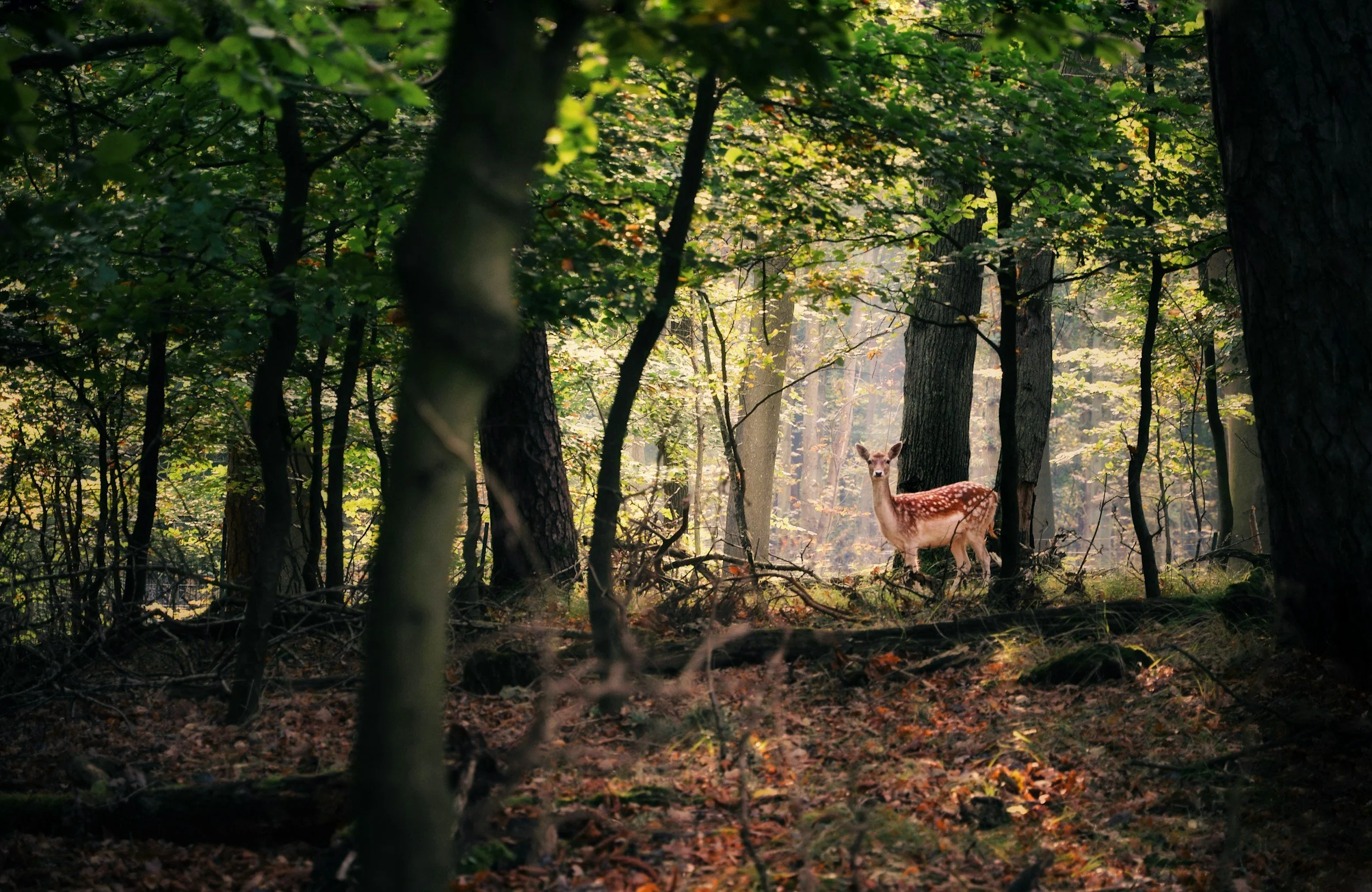
Archery deer season opens October 1, which is ten days from now, and you can already see it coming on the state forest two-tracks off Supply Road. There are trucks nosed into the sand at the end of the woods roads, somebody dragging a ladder stand, boot prints in places that had none in August.
If you're under contract on a place with woods behind it, this is the stretch of the year when you find out what the neighbors do in November. The rules are not what most buyers coming up from downstate assume they are.
The 450-foot number
Michigan has a safety zone, and the DNR's own firearms page states it in one sentence: an individual shall not hunt with a firearm within 450 feet (150 yards) of an occupied building, dwelling, house, residence, or cabin, or any barn or other building used in connection with a farm operation, without the written permission of the owner, renter, or occupant.
Written permission, not a wave from the driveway.
Two parts of that catch people. It's measured from the building, not from the property line, so a neighbor sitting on 40 acres can legally hunt nearly all of it while being closer to your house than you'd guess. And it says firearm. There is no equivalent 450-foot number anywhere in the digest for a bow or a crossbow.
So on October 1, somebody can be up a tree 60 yards off your bedroom window with a bow, on their own land, entirely legally. I'm not going to dress that up as a crisis, because the bowhunters up here are about the most careful people in the woods and the ones I know would move the stand if you asked nicely. But if you came from a subdivision in Oakland County and nobody told you, mid-November is a rough way to learn it.
The safety zone is also a hunting rule and nothing else. It doesn't touch target shooting. Somebody sighting in a rifle off their back deck the second week of November is a different question, and that one gets answered at the township. Sort of.
What a township can do about hunting, and how long it takes
Buyers call the township, ask whether there's a no-shooting ordinance, get a vague answer from whoever picks up, and let it go. Fair enough. But the answer is more interesting than vague.
A Michigan township can't just vote to close ground to hunting. Part 419 of the Natural Resources and Environmental Protection Act, MCL 324.41901 through 41905, added by 1995 PA 57, lays out the only road there is. The township board passes a certified resolution asking the DNR to recommend a closure. The DNR then sets a public hearing in the township, and the township has to find the room for it. The DNR investigates, makes findings, and prescribes the regulations. Only after all of that can the township enact an ordinance, and the statute requires that the ordinance be identical in all respects to what the department prescribed.
Then there's the signage. At least four closure notices, relatively equally spaced around the boundary, in a size and wording the DNR approves, plus a notice published for three successive weeks in a county newspaper. Nothing is closed until the signs are physically standing.
Everything that survives that process ends up in one document: the Local Hunting and Firearms Controls chapter of the Michigan Administrative Code. The state's copy is a PDF named 1015_2012-016NR_AdminCode.pdf, and it's about thirty pages of metes and bounds.
Twenty-two Michigan counties appear in it. Grand Traverse isn't one of them. Neither is Leelanau, Antrim, Benzie, or Kalkaska.
Zero closed hunting areas in the five counties we work. The closest are a portion of Bear Creek Township up in Emmet County, and Onekama Township in Manistee County, where center-fire rifles are out in the stretch bounded by Portage Point Drive and Ivanhoe Drive. Oakland County, for scale, eats roughly 840 lines of the same file by itself.
Townships around here do have noise ordinances and nuisance ordinances, and some have language on the books about discharging a firearm. Whether a given one of those holds up against a challenge is a lawyer's question and I'm not one. What I can tell you is that there is no DNR-approved hunting closure anywhere in our counties, so if somebody tells you a township doesn't allow hunting, the useful follow-up is asking which ordinance number.
When the green space behind the lot is a conservancy preserve
This comes up constantly around Traverse City, because Grand Traverse Regional Land Conservancy land is very often the handsome wooded buffer in the back third of the listing photos.
Hunting is allowed on most GTRLC preserves, deer in all seasons, and the trails stay open through hunting season rather than closing for it. Their rules keep hunters 450 feet from an occupied building and 100 feet from a maintained parking area, prohibit baiting and permanent blinds, and allow portable stands only between September 1 and April 1, labeled with the owner's name so it can be read from the ground. It's a tightly run program and the stewardship staff answers the phone. It just isn't the private park that a buffer sometimes gets sold as.
State land is the same story at a larger scale. The Pere Marquette State Forest runs across ten counties including Grand Traverse, Leelanau, Benzie, and Kalkaska, and Kalkaska County is somewhere around 40 percent state-owned. I haven't audited that percentage myself, but drive M-72 east of town in the third week of November and you'll believe it. Plenty of lots around Cedar and Maple City back onto state forest too, and when your back line is state land, your November neighbors are whoever bought a license. The DNR's Mi-HUNT viewer will show you the ownership lines in about two minutes, and it's worth the two minutes before you write rather than after.
What gives you quiet
Two things work. The first is a recorded deed restriction or plat covenant banning hunting and discharge, which is private, enforceable by the neighbors who share it, and doesn't depend on the DNR agreeing to anything. Read the covenants; don't call the township. The second is owning the ground yourself, because the safety zone measures from buildings, so the only fully reliable version of a buffer is a buffer you're on the deed for. Ten acres is not enough for this. I'd want twenty and I'd want the house near the middle of it.
Michigan's Recreational Trespass Act is also stronger than most people expect, and it's worth knowing on its own. Under MCL 324.73102, somebody needs your consent to come onto your land for a recreational activity if the land is fenced, enclosed, or posted, and if the land is in agricultural use, consent is required whether it's posted or not. That last part matters if you're buying an orchard or a hay field, along with everything else that comes with farm ground up here. Consent can be given orally or in writing. If you do post, the signs need letters at least an inch tall, at least 50 square inches of sign, and spacing tight enough that a person can see at least one sign from any point of entry.
None of which shows up on the seller's disclosure statement. There's no box for "the neighbors sit the fence line every fall."
Before you close
Walk the back property line, and look up while you're doing it. A ladder stand or a shooting lane cut through the brush is obvious in the last week of September and invisible in June, when the canopy is full and everybody is out showing houses, which is most of the reason buyers get surprised by this in the first place.
Does any of it change what a place is worth? Not much, and in Kalkaska and Antrim a hunting-friendly neighborhood is a selling point more often than it's a problem. It changes whether you're annoyed on November 15, which is a different kind of cost.
If you're looking at acreage and you want to know who else can legally be standing on the far side of your line, or you want the ownership around a lot pulled before you write, call or text me. I'll do it while you're still deciding. Same goes for anything on our current listings.
Taylor Brown, Realtor
Taylor@taylorbrownrealtor.com
(231) 360-1510
