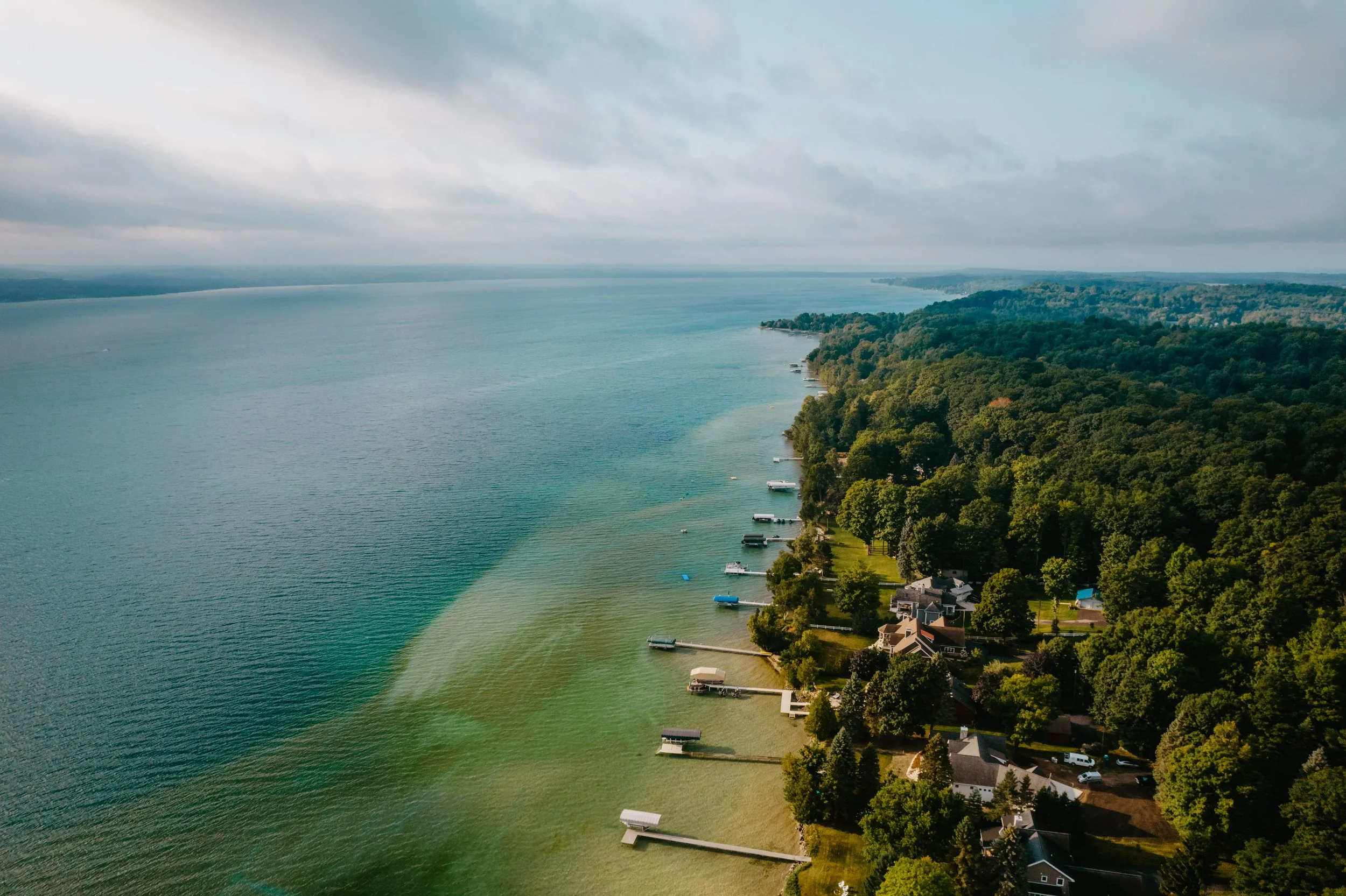
I spend a lot of time capturing the best of Northern Michigan, the sunsets over Grand Traverse Bay, the waterfront homes, the M-22 lifestyle. But as a former maritime academy graduate, I have a deep respect for the water systems that keep this region pristine. And once the drone lands and the photos are edited, a real estate transaction comes down to the dirt, the math, and the law.
Right now, one of the biggest shifts in Northern Michigan real estate is happening beneath our feet, and it directly affects every buyer and seller with a private well or septic system.
Why Michigan Is Unique (And Not in a Good Way)
Michigan is the only state in the country without a uniform statewide sanitary code. Regulation has historically been left entirely to county health departments, creating a wildly fragmented map where the rules in Frankfort were completely different from those in Williamsburg, properties just miles apart.
The environmental stakes are real. MSU researchers have found human fecal contamination affecting 100% of studied river systems in our region, with aging septic systems as the primary driver. When a septic system fails, it's rarely a dramatic sewage backup, it's a silent failure where harmful bacteria seep quietly into groundwater and coastal zones.
Protecting our lakes isn't just environmental idealism. It's protecting the core economic engine of Northern Michigan. Our local counties are taking matters into their own hands with Point of Sale (POS) ordinances that require well and septic evaluations before any property can change hands.
Grand Traverse County: The 2026 Shake-Up
Effective January 1, 2026, Grand Traverse County now enforces its "Regulation for the Evaluation of On-site Water and Sewage Disposal Systems at the Time of Property Transfer."
Unlike neighboring counties, Grand Traverse took a targeted approach with one critical rule: the mandate applies only to dwellings within 300 feet of surface water, lakes, ponds, streams, and rivers. Distance is measured from the closest exterior point of the dwelling to the high-water mark.
The county plans to eventually expand countywide to cover all 25,000 estimated septic systems, but launched with the water-adjacent properties first to avoid the bottlenecks plaguing Leelanau County.
How to check your property: Grand Traverse County's ArcGIS Tax Parcel Map Viewer has a dedicated "Time of Transfer" layer. Enter your address or parcel number and toggle it on, you'll instantly see whether you fall within the regulated zone. This is one of the first things I check when we sit down to discuss listing your home.
Who does the inspection: Grand Traverse made a smart operational call here. Instead of relying solely on municipal staff, the county allows third-party "Certified Evaluators" (vetted private inspectors) to perform the evaluations. Local companies like House Professor, Weatherstone Property Inspections, and NP Septic are already on the roster. This keeps transactions moving at market speed rather than government speed.
What they're looking for: Inspectors are checking for legally defined failure conditions, sewage backup into the structure, effluent discharging onto the ground surface, structural tank failure, liquid levels above the outlet invert, or direct discharge into water. Critically, there is a grandfather clause: functional older systems that don't meet current construction standards are not required to be replaced. If it works safely, it passes.
Benzie-Leelanau: The Stricter Standard
While Grand Traverse is just entering this arena, Benzie County has operated under a point-of-sale septic ordinance since 1992. Leelanau County joined in January 2023 under a unified Benzie-Leelanau District Health Department (BLDHD) code.
The rules here are more aggressive. There is no 300-foot buffer. Every property in both counties with a private well or septic (from a lakefront estate to a 40-acre inland hunting parcel) requires evaluation before transfer. The rule applies to nearly all forms of conveyance, including family inheritance transfers. The only exemption: properties fully connected to both municipal water and municipal sewer.
Validity windows: A passed septic evaluation is valid for three years, a major strategic advantage for sellers. Water quality tests, however, are only valid for six months due to the volatility of bacterial contamination levels.
The Leelanau Bottleneck: The Real-World Problem
Here's where things get complicated on the ground. Unlike Grand Traverse County, the BLDHD does not allow private inspectors. Only county sanitarians are authorized to perform these evaluations, and the department is severely understaffed relative to the volume of transactions it's expected to process.
These sanitarians aren't just doing real estate inspections. They're issuing new construction permits, evaluating building sites, monitoring campgrounds, overseeing food service licenses, and more. The department also absorbed unexpected funding cuts in March 2025, further straining capacity.
The official turnaround time is 6 business days for the inspection and 11 days for the report. In reality, during peak spring and summer seasons, waits of nearly a month are common. On a 30-day closing window, a delayed septic report can kill a deal entirely, buyers risk losing their locked rate, sellers relying on proceeds to close elsewhere suddenly find their entire timeline frozen. And because the BLDHD holds a monopoly on the process, you cannot pay a premium to expedite. You submit, pay the fee, and wait in line.
This is why for any Leelanau or Benzie listing, we submit the evaluation application on the day we sign the listing agreement, not after we find a buyer. We let the bureaucratic clock run while we're actively marketing the home.
The Escrow Hold-Back Strategy
If an inspection reveals a failed system, the transaction doesn't automatically die. A full drain field replacement or alternative treatment system typically runs $15,000–$35,000 depending on soil conditions and water proximity. If a seller doesn't have that liquid available before closing, we use an escrow hold-back.
Here's how it works: buyer and seller agree to close, but the title company legally sequesters a portion of the seller's proceeds, typically 1.5 to 2 times the estimated repair cost, to guarantee the work gets done. The buyer takes possession, repairs are completed post-closing using escrowed funds, the health department signs off, and the remaining balance is released to the seller.
It's a legitimate win-win: the buyer gets a compliant system, the seller closes on time without going out-of-pocket upfront, and the environment is protected. It does require a lender willing to underwrite the hold-back terms and sufficient seller equity to absorb the withheld funds at closing.
Winter Inspections: Separating Myth from Reality
There's a persistent myth that septic systems can't be inspected in winter. Because of it, sellers delay listing until spring and miss a pool of highly motivated off-season buyers.
The truth: winter inspections are entirely possible with proper preparation.
Active septic tanks generate significant biological heat that keeps effluent liquid even in sub-zero temperatures. The real challenge is access and drain field protection.
Before the first snowfall: Mark the exact locations of tank access points, the distribution box, and the wellhead with tall, visible fiberglass stakes. When three feet of lake-effect snow covers the yard, those components disappear entirely. Clear snow from access points before the evaluator arrives.
Do not touch the drain field: Snow acts as a critical insulator, trapping geothermal heat and preventing the frost line from penetrating the lateral lines. Plowing the drain field or allowing vehicle traffic over it removes that insulation and can cause catastrophic, irreversible system failure mid-transaction. Keep all foot and vehicle traffic off it entirely.
Vacant homes: If you vacate before closing, the system loses its daily thermal input from showers and laundry. Keep the heat on. Have someone run warm water periodically to maintain line temperature. Never use antifreeze or chemicals to thaw a frozen system, you'll destroy the bacterial biome, damage the piping, and risk serious environmental fines.
What Buyers Need to Know
These ordinances are genuinely good news for buyers, they're eliminating the era of purchasing a beautiful waterfront home and discovering a catastrophically failed system hidden under a manicured lawn. But you still need to be sharp.
Validate the paperwork: A standard home inspector does not cover septic systems. In Leelanau and Benzie, a report from a private pumping company has zero legal standing, it must bear the official BLDHD seal. In Grand Traverse County, verify the evaluator is on the GTCHD certified roster.
Check system capacity: A passed inspection confirms the system currently functions, it does not guarantee it can handle your renovation plans. Septic systems are engineered by bedroom count, not square footage. If you buy a two-bedroom home and plan to add a suite, the existing system may be legally insufficient for the expanded use. We pull original septic permit records from the Environmental Health Digital Records Portal before you finalize any plans.
Check the Wellogic database: Michigan maintains a statewide groundwater database called Wellogic with well construction records for wells drilled since 2000. We pull these records to verify depth, yield, and geological construction of your drinking water source before closing.
Post-closing stewardship: Once it's yours, protect the system. Limit garbage disposal use, never flush grease, stagger heavy water usage to avoid hydraulic overload, and never park vehicles on the drain field. My wife Sarah and I try to keep our home environment as clean as possible (including what goes down the drain) and the same approach keeps a septic system healthy for decades.
The implementation of Grand Traverse County's 2026 ordinance and the BLDHD's existing universal mandate represent a permanent shift in how property transfers in Northern Michigan. These aren't bureaucratic obstacles, they're safeguards ensuring the lakes, rivers, and groundwater that make this region irreplaceable stay that way.
As your real estate partner, I don't panic when the rules change. Between raising Lenny, managing the chickens, and closing deals with Janel, I've learned that preparation and local knowledge beat bureaucratic friction every time. If you're thinking about buying or selling in Traverse City, Leelanau, or Williamsburg, let's get ahead of it together.
