Written in February 2026. The market numbers below are from that month and have moved since, so ask us for today's.
If you spend enough time navigating the woods, waters, and backroads of Grand Traverse and Leelanau Counties, you learn to read the terrain. As of February 2026, the local housing market is shifting under our feet, and heading into the 2026 building season, we’re looking at a brand new landscape.
The era of the attainable custom home, that dream of buying a quiet piece of acreage and building a custom cabin for under $250 a square foot, is officially extinct.
My working number for early 2026 is a baseline of about $400 per square foot for a custom project. It is my estimate. Your builder’s written bid is the number that counts.
This isn't just a temporary inflationary spike, it’s a structural shift in the ecosystem. It’s driven by a severe shortage of skilled hands, intensified environmental red tape from health departments, and the hard truth that cheap dirt usually requires a small fortune to make buildable.
Here is the unvarnished, data driven debrief on what it actually costs to build in Northern Michigan as of February 2026, and how my mom and business partner, Janel, and I are helping clients navigate the terrain.
1. The Macro Economics, The $400 per Sq. Ft. Reality Check
To understand the price tag, you have to look at the forces driving it. While commodities like lumber might bounce around, the total cost to put keys in a door keeps climbing.
The Baseline Build When we say $400 per square foot is the starting line, we aren't talking about a luxury estate. For a standard 2,500 square foot home, you are looking at a $1,000,000 construction budget, and that’s before you buy the land or carve out a driveway.
At that price point, you’re getting a solid, quality build:
Exterior: LP SmartSide or high quality vinyl, standard asphalt shingles, and double pane vinyl windows.
Interior: LVT flooring or mid range engineered hardwood, quartz counters, and paint grade trim.
Systems: Standard high efficiency forced air, PEX plumbing, and a 200 amp panel.
If you want to upgrade to that true Leelanau Aesthetic, Andersen 400 series windows, natural stone masonry, cedar shakes, or geothermal heating, you are rapidly pushing into the $600 to $800+ per square foot territory.
The Windshield Time Tax The most stubborn hurdle in Northern Michigan is the Housing Labor Paradox. The guys who know how to swing a hammer can’t afford to live near the job sites.
When you build out on Old Mission or deep in Leelanau, you are paying general contractors premium wages to truck crews in from Wexford, Kalkaska, and Antrim counties. You are paying for their windshield time. Because skilled labor is so scarce, subcontractors hold all the cards. Bids can expire in as little as two weeks, and if your site isn’t ready when they show up, you lose your slot, sometimes for months.
The Supply Chain Slog Materials take time. Custom window packages can carry lead times of three or four months. Builders are forced to order, and you are forced to pay for, these components before the foundation is even poured, which requires a heavy payload of cash upfront.
2. The Spec Route, The Price Per Square Foot Illusion
For buyers who don’t want to endure an 18 month expedition and the wild variables of a custom build, the spec (speculative) market is the alternative. And if you understand how real estate math actually works, it’s where the value is.
When people see a high-end spec home sell, they often miscalculate the true cost to build it themselves because they misunderstand how price per square foot is calculated.
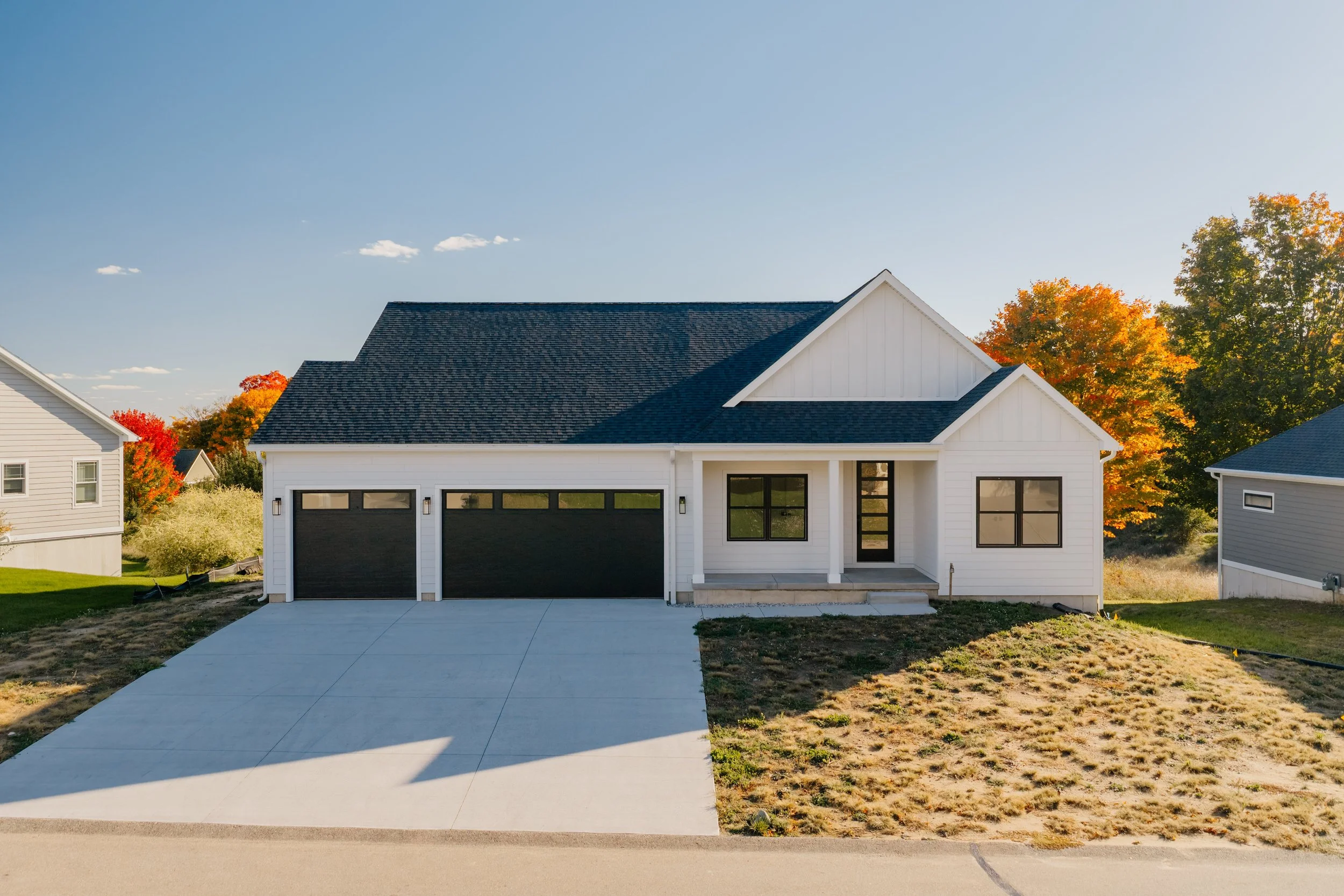
Take a new construction listing Janel and I sold in the Lone Tree development at 4311 Apple Tree Lane. It’s a stunning 5 bedroom, 3 bath home with quartz counters, luxury vinyl plank floors, and LP Smartside. It closed for $812,500 , and on paper, the listing showed $253.12 per square foot.
Sounds like a steal compared to my $400 per sq. ft. custom build warning, right?
Here is the catch: That $253 number is a blended rate. It takes the total sale price and divides it by all 3,210 finished square feet. But 1,305 of those square feet are in the finished lower level.
Pouring a basement and finishing it out is vastly cheaper per square foot than building the main structural shell of the house (the roof, the foundation, the exterior walls, the kitchen). That cheaper basement space heavily dilutes the average.
When a custom builder quotes you a starting price of $400 per square foot, they are typically quoting the above grade space (which is 1,905 square feet on that Apple Tree house). Finishing the basement is usually an add on.
Plus, that Apple Tree home was hooked up to municipal water and sewer.
If you bought a raw piece of rural land and hired a custom builder to recreate that exact same house, your main floor build cost would be hovering right around that $400 mark. Then you’d pay to finish the basement. Then you’d have to write checks for a private well, a septic system, and site clearing.
This is exactly why buying an efficient, new construction spec home as of February 2026 is beating the custom scattered lot market every single time. You get the scale, and you avoid the site prep gamble.
3. The Dirt, Land Scarcity and the Invisible Costs
In 2026, the purchase price of raw land is just your entry fee.
The dollar ranges below are my rough estimates as of early 2026. Get real bids from an excavator, a well driller and a septic installer before you lean on any of them.
The easy lots, flat, sandy soil with utilities at the road, are basically gone. There are far fewer vacant lots on the market than there were before 2020. Buyers are being pushed into the backcountry toward challenged parcels: steep slopes, heavy clay, and wetlands.
The Site Prep Bundle Never underestimate the cost of moving dirt. A cheap $40,000 wooded lot can easily demand $80,000+ in site prep before you pour an ounce of concrete.
Clearing and Grading: Dropping trees and pulling stumps costs $1,500 to $5,000+ per acre. Carving a build site into a glacial hillside requires massive cut and fill work and retaining walls.
The Long Driveway: A 100 foot gravel drive is cheap. But rural parcels often require 500 to 1,000 feet of access. At $15 to $25 per linear foot, a 1,000 foot gravel roadbed is a $15,000 to $25,000 line item. Paving it pushes this cost to $50,000+.
Utilities: With many buildable lots located outside municipal districts, private wells and septic systems are the norm.
The Well: Depths vary wildly, expect $6,000 to $15,000+. This is exactly why Janel and I always pull the neighboring health department logs to see how deep the neighbors had to drill before you ever make an offer.
The Septic: Sandy soil gets you a conventional system for $6,000 to $12,000. But if you hit heavy clay, which is very common in Leelanau, the health department can require an engineered or mound system instead, and I’d plan on $20,000 to $35,000+ for one.
4. Navigating the Red Tape, EGLE and Zoning
The build anywhere pioneer days are over. Today, you share jurisdiction with the Township, the County, and the State.
The Michigan Department of Environment, Great Lakes, and Energy (EGLE) regulates wetlands under Part 303 of state law. A lot does not have to be wet all the time to count as a wetland. EGLE looks at the soils, the plants and signs of water. A wetland is generally regulated if it connects to or sits within 500 feet of a lake, pond, river or stream, or if it is bigger than five acres. A lot that looks bone dry in August can still need an EGLE permit before you fill, grade or build a driveway across it, and that review takes time, so start early. EGLE also runs a fee-based Wetland Identification Program if you want an answer on a specific lot before you close.
5. The City Alternative, The Renovation Play
With the cost and timeline of new construction so high, renovating an existing home is often the smartest tactical move, but the map has changed there, too.
Vacant lots in an established downtown neighborhood like Slabtown almost never come up for sale. If you want to be there, you have to renovate. Even in the Central Neighborhood, the few buildable lots that come up are small, and they are priced high for what is just the dirt.
With new construction running around $400 per sq. ft., the replacement cost of homes in these prime locations is sky high. This actually protects your investment if you decide to buy a dated home and renovate it. You are buying the one thing you can't build: location.
6. Janel and Taylor's Bottom Line
The Traverse City and Leelanau market in 2026 is defined by one word: Scarcity. Scarcity of labor, scarcity of buildable land, and scarcity of time combine to create a high barrier market.
So, what do we do with all this?
For Land Buyers: Due diligence is paramount. Never purchase land without considering a percolation test and checking to see if there is a survey on file. Let us pull the well logs for the neighbors so you know exactly what you're getting into. I’d budget $40,000 to $60,000 in site work on a raw lot, on top of the price tag, until an excavator tells you otherwise.
For Home Buyers: If you want new, you need connections. We work with multiple spec home builders who have upcoming inventory that isn't always on Zillow yet. These are the guys building efficient homes that actually make financial sense.
The Takeaway Building a custom home in 2026 is a luxury service for getting exactly what you want, if you have the budget and the patience.
For everyone else? Let’s go find a solid existing home in a killer location, or get you in with one of our preferred builders who can deliver a new home without the custom price tag.
Checked against the sources linked above in October 2026. The construction and site cost figures are my own estimates and have no public source, so treat them as a starting point and confirm with your builder, the health department and EGLE.
