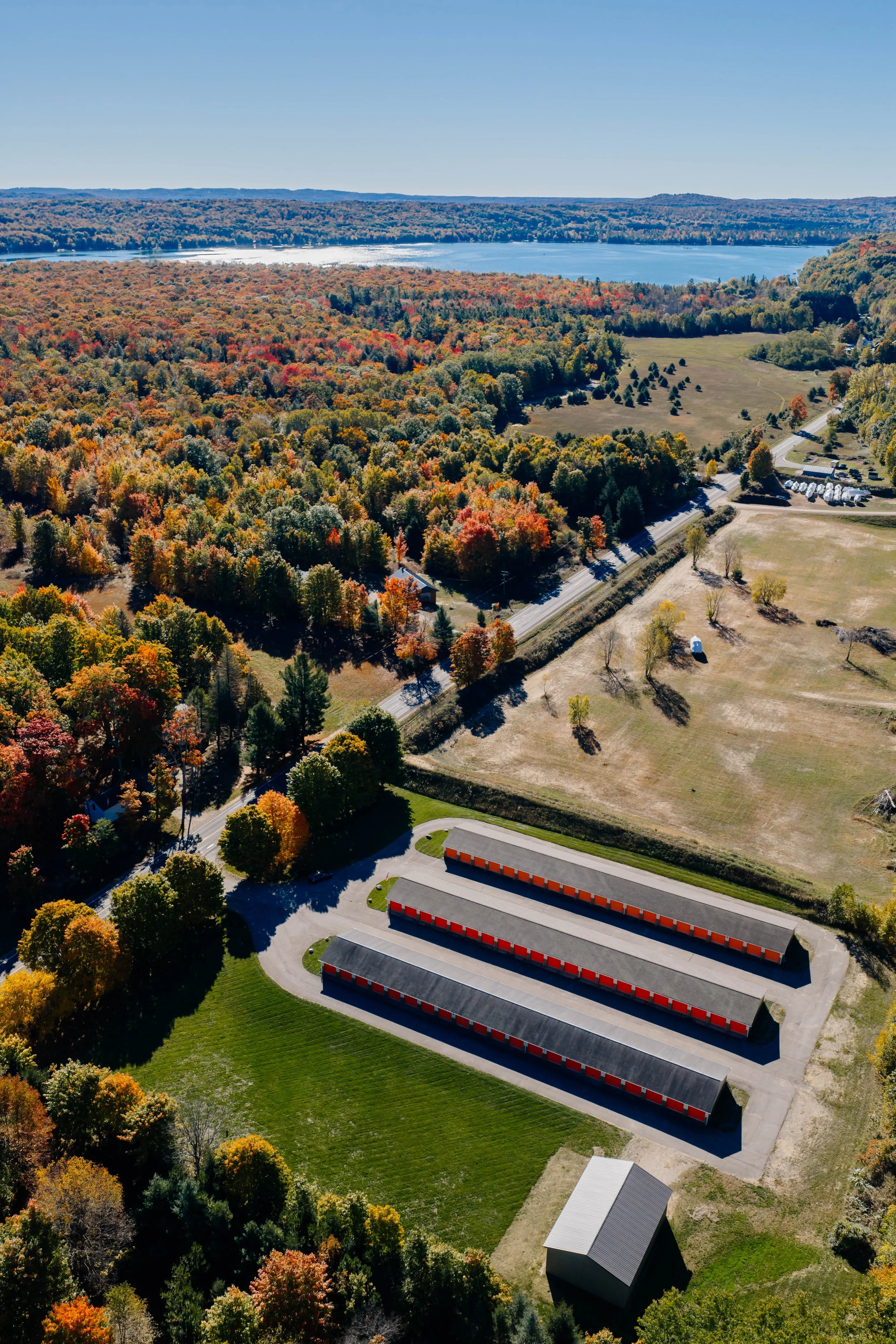
If you’ve driven down M-37 or through the Silver Lake corridor lately, you’ve probably noticed a shift in the landscape. It used to be that the "Up North" dream was simple: a cottage on the lake and maybe a shed for the lawnmower.
But let’s be real, the toys have changed.
The modern Northern Michigan lifestyle isn't just about the view anymore; it’s about the gear. We’re seeing $200,000 surf boats with sensitive electronics, Class A motorhomes that rival small apartments, and fleets of snowmobiles that need a home year-round. You can’t just throw a blue tarp over a wake boat with a digitally integrated ballast system and expect it to survive a Traverse City winter intact.
This shift has created a unique problem that Janel and I see constantly. We have clients securing incredible waterfront properties on East Bay or Lake Leelanau, only to realize the lot is too narrow or the HOA is too strict to house the "recreational fleet."
So, the natural thought is: "I’ll just buy a few acres of vacant land nearby and build a pole barn."
And that is where the trouble begins.
The "Accessory Before Principal" Roadblock
Here is the hard truth that catches so many buyers off guard: In a lot of our local townships, you cannot put up a storage barn on vacant land until there is a house.
The zoning shorthand is accessory before principal. A barn counts as an “accessory” to a house, and if there is no house (the “principal”), the township won’t issue the permit. East Bay Township spells it out in Section 5.1(F) of its zoning ordinance: no accessory building before the principal structure. The exceptions there are agricultural buildings and a temporary use permit good for up to one year, which comes with a performance guarantee. Elmwood Township (Section 3.6) allows a standalone accessory building only where farming is the primary use of the parcel. Peninsula Township’s ordinance permits accessory buildings “with a single-family dwelling” in its residential districts (Section 6.2.2), so call the zoning office before you assume a barn can go up alone. For the guy who just wants a heated spot for his boat, it’s a major headache.
Janel and I have stood on countless beautiful, wooded 5-acre parcels with clients who have the cash and the blueprints for a dream barn ready to go, only to have to be the bearers of bad news: unless you build a house first, that barn isn't happening.
The Exception to the Rule
Now, real estate is all about knowing the local quirks, and there are exceptions if you know where to look.
If your strategy is to build a massive toy barn now and maybe a retirement home in ten years, you need to look at Almira Township (think Lake Ann area). Section 4.04(D) of Almira’s zoning ordinance allows an accessory structure to go up before the principal building, as long as nobody sleeps or lodges in it and it isn’t a home business. You still need a zoning permit, and the setbacks are the same as for a house. I covered more townships in Pole Barn First, House Later.
The Solution: The Rise of the "Storage Condo"
Because building on your own land is so legally tangled, the market has responded with a new class of real estate: the Storage Condominium.
These aren't your standard monthly rental units. These are deeded units that you own, just like a condo. And honestly, they are evolving into lifestyle spaces, part garage, part "man cave."
We are seeing a massive boom in this sector right now:
The Luxury Tier: Developments like the M-37 Round About Barns are setting the standard. These units are marketed as fully finished, with epoxy floors, R-19 insulation, and 60lb snow-load trusses. When I wrote this in February 2026 they were priced in the $150k to $175k range, so check current listings, but they offer climate control that protects your assets better than almost anything else.
The Heavy Haulers: Over on the west side, the Silver Lake Storage Barns are catering to the big rigs. We’re talking 48' x 80' units that were listed near $300k in early 2026. It sounds steep until you realize it’s housing half a million dollars worth of vehicles.
For many of our clients, this is the math that makes sense: Buy the waterfront house for the family, and buy the storage condo for the peace of mind.
The "Barndominium" Reality Check
I also have to touch on the "Barndominium" trend because it comes up in conversation weekly. The idea of a steel building that is half-shop, half-house is incredibly cool, but financing them can be tricky.
Banks often struggle to appraise them because there aren't enough similar "comps" in the neighborhood. Plus, to legally live in it, the structure still has to meet the residential building code (footings below frost, insulation, egress windows), and the county building department decides what that takes. By the time you retro-fit a pole barn to meet those codes, the "cheap" price tag often disappears.
Navigating the Maze
The bottom line is that the "Toy Storage" market in Traverse City is booming, but it’s complex. It’s a rational response to a region that is attracting more wealth and more toys, but hasn't updated its zoning maps to catch up.
Whether you are looking for that rare parcel in Almira where you can build freely, or you want to tour a luxury storage condo to see if your RV fits, you need a strategy before you sign. Janel and I are here to help you navigate the zoning maps, run the numbers, and make sure your toys have a home as nice as yours.
Checked against the sources linked above in October 2026. The storage condo prices are from when I first wrote this in February 2026 and have no public source, so check current listings. Zoning ordinances get amended, so confirm with the township zoning administrator before you buy land for a barn.
