Written in March 2026. The market numbers below are from that month and have moved since, so ask us for today's.
A Village of 900 People With a Million Houseguests
Glen Arbor has roughly 900 year-round residents. Sleeping Bear Dunes National Lakeshore — which basically wraps around the town like a 71,000-acre bear hug — draws over a million visitors a year. If you do the math on that ratio, it's roughly 1,100 tourists for every permanent resident, every single year.
That's not a typo. And it's exactly why Glen Arbor real estate behaves like nothing else in Northern Michigan.
Most people know Glen Arbor as the cute little town you drive through on M-22 after the Dune Climb, the place where you grab ice cream at Cherry Republic before heading back to wherever you're staying. But underneath that postcard-perfect surface is one of the tightest, most unusual real estate micro-markets in the state — and if you're thinking about buying here, there are a few things worth understanding before you fall in love with a listing on Zillow at midnight.
The Geography That Makes Everything Weird
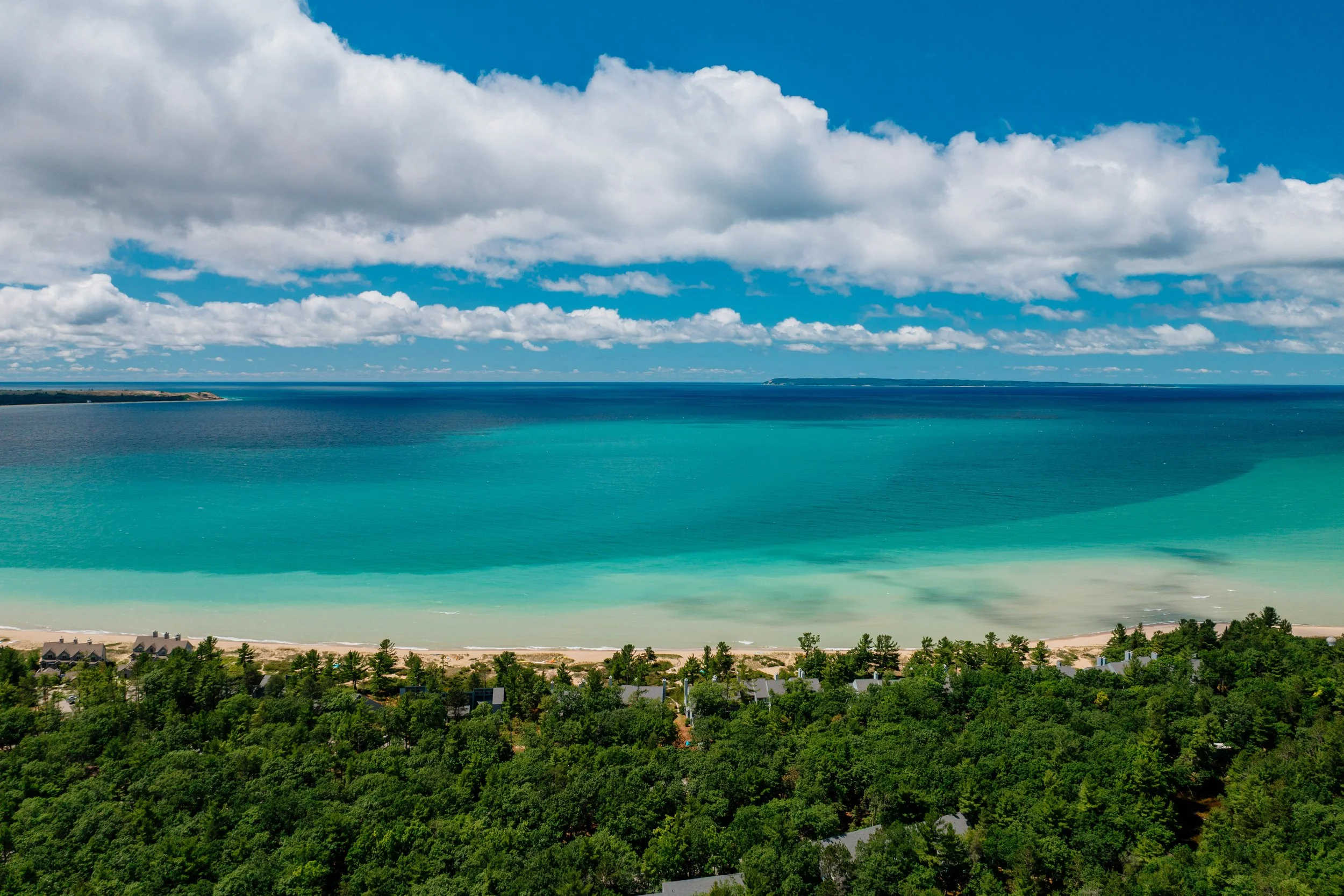
Here's what makes Glen Arbor different from basically everywhere else in Traverse City's orbit: it's almost entirely surrounded by federally protected land. Sleeping Bear Dunes National Lakeshore covers 35 miles of Lake Michigan coastline and tens of thousands of acres of forest, dunes, and inland lakes. That land isn't getting developed. Ever. The National Park Service doesn't sell parcels.
What that means for real estate is simple but profound: the supply of buildable land in and around Glen Arbor is essentially fixed. You can't sprawl. You can't subdivide your way into more inventory. What exists is what there is, and what there is ain't much.
The result? A median home value that ranges wildly depending on who's doing the counting — somewhere between $400,000 and $775,000, with the spread reflecting the massive gap between a modest cabin on the inland side and a lakefront estate with views of Sleeping Bear Bay. For context, Leelanau County as a whole had just 55 homes for sale as of mid-March. Glen Arbor's slice of that inventory is even thinner.
Two Lakes, Two Completely Different Markets
People talk about "Glen Arbor waterfront" like it's one thing. It's not. There are really two distinct markets here, and they behave differently.
Glen Lake is the inland lake — Big Glen and Little Glen, technically two lakes connected by a narrow channel called The Narrows. Big Glen is deep, clear, and absolutely gorgeous. It's the lake where families have been spending summers for generations. Waterfront on Big Glen starts around $800,000 for something that needs work and goes north of $2 million pretty quickly for anything updated with good frontage. Little Glen is shallower, warmer, and generally a bit more accessible price-wise, though "accessible" is doing a lot of heavy lifting in that sentence.
Lake Michigan frontage near Glen Arbor is another animal entirely. Most of the Lake Michigan shoreline here falls within the National Lakeshore, so private lakefront parcels are exceptionally rare. When they do come up, they move fast and they move high. We're talking seven figures as a starting point, and the competition often includes cash buyers from Chicago, Detroit, and increasingly from further afield.
Working in this market, you learn to read between the lines of every listing. "Lake views" doesn't mean "lakefront." "Walking distance t
The Homestead Factor
You can't talk about Glen Arbor real estate without talking about The Homestead. It's the resort community that sits right on Lake Michigan with ski-in/ski-out access in winter and beachfront in summer. Condos and homes within The Homestead operate as their own sub-market with their own pricing dynamics, their own HOA structures, and their own rental management programs.
For buyers who want a turnkey vacation property with built-in amenities — golf, dining, a spa, managed rentals — The Homestead is genuinely appealing. But it's not for everyone. The HOA fees can be substantial, the rental rules have their own learning curve, and you're buying into a resort community rather than owning a standalone piece of Northern Michigan. Some people love that. Others want the cabin-in-the-woods experience. Know which camp you're in before you start shopping.
The STR Question Everyone Asks
Here's where it gets spicy. Glen Arbor sits at the intersection of two powerful forces: massive tourist demand and a tiny housing stock. That makes it incredibly attractive for short-term rentals — and incredibly contentious when it comes to STR regulation.
Leelanau County and its townships have been navigating STR ordinances for years, and the rules vary by jurisdiction. Glen Arbor Township has its own approach, and it's worth doing your homework before assuming you can buy a property and immediately list it on Airbnb. Zoning districts, permit requirements, occupancy limits, and noise ordinances all come into play. If you're buying with rental income as part of your financial equation, get the regulatory details locked down before you make an offer, not after. We've put together a comprehensive short-term rental guide that covers the landscape across the region.
That said, the rental potential here is real. A well-located, well-maintained property in Glen Arbor can generate meaningful income during peak season — roughly Memorial Day through Labor Day, with shoulder seasons picking up more each year as the fall color crowd and winter sports visitors grow. The million-plus visitors aren't going away. If anything, that number keeps climbing.
What It's Actually Like to Live Here Year-Round
This is the part most real estate blogs skip, so let me be direct: Glen Arbor in January is a very different place than Glen Arbor in July.
In summer, the town buzzes. M-22 is bumper-to-bumper on weekends. Every restaurant has a wait. The beaches are packed. Cherry Republic has a line out the door. It's vibrant and fun and a little bit chaotic, and honestly, it's one of the best places in the Midwest during those months.
In winter, the population drops back to that core 900. Many restaurants close or go to limited hours. The Homestead runs its ski operation, which brings some activity, but the overall pace downshifts dramatically. Your nearest full-service grocery store is a drive. The nearest hospital is in Traverse City, about 25 to 30 minutes down M-72. If you need anything from a hardware store at 8 p.m. on a Tuesday in February, you're driving to TC.
For people who love that quietness — the kind of people who want to cross-country ski through Sleeping Bear at sunrise without seeing another soul — it's paradise. For people who need year-round social infrastructure, dining options, and quick access to services, it can feel isolating. Neither reaction is wrong. But you should be honest with yourself about which one you are before you buy.
The 15-Minute Drive Test
Here's a framework I think is genuinely useful for anyone considering Glen Arbor: make a list of the five things you do most often in a typical week. Grocery shopping. Getting coffee. Going to the gym. Seeing friends. Whatever your version of normal life looks like. Then check how many of those things are within a 15-minute drive of the property you're considering.
In Traverse City, most people hit all five. In Suttons Bay, you probably hit three or four. In Glen Arbor, you might hit one or two — and that's fine, as long as you go in with eyes open. The beauty and privacy of this area is directly related to its remoteness. That's a feature, not a bug, for the right buyer.
Who Glen Arbor Is Really For
Over the years, Janel and I have noticed a pretty consistent profile of the buyer who thrives in Glen Arbor. They tend to be second-home buyers who want a dedicated escape from a metro area — Chicago, Detroit, Grand Rapids, increasingly from out of state. They value natural beauty and outdoor access over nightlife and walkable downtowns. They're comfortable with seasonal rhythms and don't mind that their favorite restaurant might be closed four months of the year.
They also tend to have a longer time horizon. Glen Arbor isn't a flip market. It's a place where people buy because they've been coming here for years and finally decided they're done renting. The emotional pull is real — this is the town where Good Morning America's viewers voted Sleeping Bear Dunes the Most Beautiful Place in America, and once you've spent a July evening watching the sunset from the Dune Climb, you understand why.
If that sounds like you, Glen Arbor might be worth a serious look. Just go in with realistic expectations about inventory, pricing, and what year-round life actually looks like. And maybe don't make any decisions at midnight on Zillow.
Want to talk through what's actually available in the Glen Arbor area as of March 2026? I'm happy to walk you through it.
Taylor Brown, Realtor
Taylor@taylorbrownrealtor.com
(231) 360-1510
